This blog aims at bringing out the past glory and history of India, Hinduism and its forgotten values and wisdom. This is not copyrighted so as to reach genuine seekers of these information. Its my prayer that only genuine seekers - and not vandals & plagiarists - come to this site.
What did Onam originally signify, and how did its meaning evolve into what it represents today?
Onam is associated with Śravaṇa nakṣatra, called Tiruvōṇam (திருவோணம்) in Tamil, traditionally regarded as Vishnu’s birth star. Today, Onam is popularly associated with the annual return of Mahābali, whose story is linked to Vishnu’s Vāmana avatāra. Yet the earliest Tamil references suggest a different association.
1. Tiruvōṇam and Narasimha — Periyāḻvār
Periyāḻvār, in the sixth verse of Tiruppallāṇḍu, says:
திருவோணத் திருவிழவில்
அந்தியம் போதில் அரியுருவாகி
அரியை அழித்தவனை
The verse explicitly refers to the Tiruvōṇam festival and to Vishnu assuming the form of Narasimha and destroying the enemy. It was not associated with Vāmana or Mahābali.
Another Periyāḻvār verse contains the expression:
அத்தத்தின் பத்தாம் நாள்
தோன்றிய அச்சுதன்
referring to Achyuta (Vishnu) appearing on the tenth day from Hasta (Attam), identified with Śravaṇa/Tiruvōṇam. The correspondence with the present Kerala practice is striking: Onam celebrations begin with Atham (Hasta) and culminate in Thiruvonam. While this alone cannot prove uninterrupted continuity, it is an intriguing parallel.
2. From victory over evil to Ayudha Pūjā
A second Tamil reference occurs in Tirujñāna Sambandar’s Dēvāram, in connection with the Kapālīśvara temple at Mylapore, where an Aippasi Onam is mentioned. This falls around Mahā Navami, the traditional period of weapon worship (Ayudha Puja) and preparation for warfare.
The Thiruvakkarai inscription of 897 CE similarly mentions “பிரட்டாதி ஓணமும்”(Purattasi Onam). These references suggest that Onam was not restricted to a Vishnu festival but had acquired a wider cultural significance involving war preparedness and weapon worship.
3. The emergence of Mahābali
A third strand appears in the Sangam work Maturaikkāñci:
கணம் கொள் அவுணர்க் கடந்த பொலந் தார்
மாயோன் மேய ஓண நல் நாள்.
Onam is described as the auspicious day of Māyōn (Vishnu), the destroyer of the powerful Asuras. This may connect with the later Mahābali tradition. The Padma Purāṇa and Skanda Purāṇa describe kings of earlier times honouring Mahābali on his return by floral decorations and donations, seeking prosperity and land.
The associated observance was Bali Pratipat in Aippasi. The Onam of Maturaikkāñci may preserve an early form of this tradition, although the text itself does not explicitly name Mahābali. Over time, the celebration appears to have shifted in calendar and geography, becoming associated in Kerala with Chingam (Siṃha māsa) and Tiruvōṇam.
4. The Kerala evidence
By the early medieval period, Onam was firmly established in Kerala. The Thiruvalla copper plate of c. 861 CE provides early epigraphic evidence, while 11th–12th-century inscriptions at Thiruvalla and Thrikkakara show the festival becoming institutionalised through temple rituals and celebrations.
The evidence therefore points to a long and complex evolution: from Tiruvōṇam associated with Vishnu/Narasimha and victory over evil, through traditions involving weapon worship and royal observances, to the now prominent Mahābali tradition of his annual return. The modern characterization of Onam primarily as a harvest festival may be a recent addition.
Who was Murugan? Was he merely a deity of the Tamil hills? Was he the pan-Indian Skanda, Kārttikeya and Subrahmaṇya? Or, as some modern Tamil narratives claim, was he an ancient ancestor—a Muppāṭṭan?
In my recent discussion on Murugan to SwadeshiTamil Channel, I examined these questions by bringing together Tamil literary traditions, Sanskrit sources, Vedic references, geographical evidence, climatic records and even some intriguing genetic findings.
My conclusion is different from both the conventional extremes. Murugan is indeed a God—but he was born as a man and was elevated to divine status. He is not our ancestor or Muppāṭṭan. Yet he occupies a unique place in our tradition as the forerunner of those who perform Vedic Homa.
Murugan's birth in Then Madurai
An important source that is often overlooked in discussions about Murugan's origin is the Tiruvilaiyādal Purāṇam. It gives an account of Murugan's birth that is very different from the familiar Puranic narrative of his birth from Shiva's divine fire.
According to this Tamil tradition, Murugan was born as Ugra Kumāra, the son of Tadātakai Pirāṭṭi and Somasundara in Then Madurai — Southern Madurai.
The place is described as Kanni Desam. I specifically distinguish this from the modern concept of Kumari Kandam. The two should not simply be equated.
The question then naturally arises: Where was this Southern Madurai?
This is where geography becomes important. I have examined bathymetric studies of the region and identified what I consider to be the probable location of the ancient Southern Madurai. This is not merely a matter of taking the traditional name and placing it somewhere on a modern map. The geographical evidence has to be examined alongside the literary descriptions.
A land that disappeared
The Tamil literary tradition preserves memories of Southern Madurai being lost beneath the sea.
The accounts associated with Nakkīrar, Ilam Pūraṇar and Adiyārkkunallār speak of the submergence or loss of the ancient southern land. I therefore do not treat the disappearance of Southern Madurai as merely a poetic invention.
There are also indications of floods before and during the period associated with Murugan, together with references that can be interpreted in the context of volcanic activity.
When these literary traditions are examined alongside climatic and geological records, an intriguing chronology emerges.
My assessment is that Murugan belongs to a period before the Holocene, roughly around 12,000 years ago. This places the Murugan tradition in a very different chronological framework from the one usually assumed.
Murugan, Kārttikeya and the re-design of the zodiac
One of the most interesting aspects of Murugan's identity emerges when we look at his astronomical associations.
The name Kārttikeya, is connected with an important astronomical change attributed to Murugan: the re-designing of the zodiac of lunar mansions.
The Mahābhārata preserves an account in which sage Mārkaṇḍeya narrates matters concerning the nakṣatras to the Pāṇḍavas. In this narration we encounter the significance of the change from the earlier arrangement.
As per this, the star Abhijit was dropped from the nakṣatra scheme and Kṛttikā was included so that the zodiac could remain as a system of 27 nakṣatras.
This provides a possible astronomical dimension to the name Kārttikeya itself, connecting Murugan with Kṛttikā.
How did Murugan become Viśākha?
The astronomical story does not end with Kṛttikā.
I also examine the association of Murugan with Viśākha.
The significance becomes clearer when we consider the astronomical reorganisation of the nakṣatra system. In the process of re-designing the zodiac, Viśākha occupies a special position because the star-group extends across two zodiacal signs in the autumnal equinoctial position.
Vivasvān, the present Sun, and Manu, who initiated the Ikṣvāku dynasty, came into being after this event. Viśākhā was subsequently adopted as the Kula Nakṣatra of the Ikṣvākus, as we learn from the Vālmīki Rāmāyaṇa.
Thus Murugan's different names and associations may preserve memories of astronomical events or changes that are far older than the later popular stories attached to him.
The connection among Kārttikeya, Kṛttikā, Viśākha and the nakṣatra system therefore deserves to be studied as an astronomical tradition in its own right.
This is particularly important because Indian traditions often preserve astronomical information through the names and stories of deities rather than presenting it as a modern scientific textbook.
Was Murugan only a Tamil deity?
Another question I examine is whether Murugan was originally a purely Tamil deity who was later transformed into Skanda or Kārttikeya.
I find this too simplistic.
The ancient Tamil tradition certainly preserves a very strong and distinctive Murugan tradition. At the same time, the Sanskrit tradition knows him by several names, including Kārttikeya and Skanda, and there are Vedic references connected with Subrahmaṇya.
I also compare these with the Mahābhārata's references to Murugan and his different names, as well as the Tamil Tirumurukāṟṟuppaṭai.
These sources have to be studied together rather than placing "Tamil Murugan" on one side and "Sanskrit Skanda" on the other and assuming that they necessarily represent unrelated traditions.
The red-headed Murugan
There is another unusual feature that I discuss: Murugan's red head or reddish appearance.
This becomes particularly interesting when we consider ancient populations outside India. Genetic studies of red-haired populations in Ireland and Scandinavia have been interpreted as pointing to a mutation that arose in an individual in India roughly 10,000 years ago.
This is an intriguing piece of evidence when considered alongside the ancient traditions.
The Scythians, too, are described as red-haired in historical sources, and I point out the association of objects and practices connected with Murugan among them. These parallels deserve investigation rather than being dismissed simply because they do not fit neatly into modern geographical categories.
Was Murugan a man who became God?
This brings me to the central question.
Was Murugan a God?
My answer is yes.
But I do not believe that this necessarily means that he was born as a supernatural being in the way later mythology presents him. My interpretation is that Murugan was born as a man and was subsequently elevated to the status of a God.
In other words, the categories "man" and "God" need not be mutually exclusive in the ancient Indian understanding of history and divinity.
A human being of extraordinary stature could become divinised and worshipped as a deity. Murugan, in my interpretation, represents such a case.
But was he our Muppāṭṭan?
Here I differ from another popular Tamil claim.
Some argue that Murugan was the ancient Tamil Muppāṭṭan—our forefather or ancestor.
I do not agree.
Murugan should not be reduced to the status of an ancestral figure merely because he was born as a man.
There is, however, another reason why I regard him as having an extraordinary place in our tradition.
The first Vedic Homa
Murugan is associated with the initiation of the first Vedic Homa.
Therefore, rather than calling him our Muppāṭṭan, I would describe him as a forerunner of everyone who performs Homa.
This gives an entirely different significance to his place in the religious tradition.
He is not merely a Tamil hill deity who was subsequently absorbed into a northern Sanskritic tradition. Nor is he simply a human ancestor elevated by later generations.
He stands at a much deeper point in the history of our religious tradition.
Vedic astronomy is a fascinating term these days that
a number people are giving lectures on ‘Vedic astronomy’ of equinoxes and pole
stars in particular without realizing that they are repeating western concepts
of the same. My long-time followers know how I faced ridicule, dismissal, and
even abuse for discussing the oscillatory motion of equinoxes, as described in
Surya Siddhanta and calculated by Mr. Vinay Jha and incorporated in Jhora
software. Critics claimed this concept was absurd, unaware that it's rooted in
ancient Siddhanta-s and integral to our traditional calendar and horoscope
construction. The deduction of ayanamsa from Western ephemeris is a direct
result of this understanding.
Some time ago, a senior IVC scholar challenged me on
Twitter to get this concept published, which was subsequently published twice,
earlier in The Astrological Magazine and now by IKS. I learned that certain research scholars are seriously exploring this topic and
have provided mathematical calculations on how the Sun could move in a
to-and-fro motion.
The basis for convincing scientists came when I wrote
an article on how ancient structures built in various millennia are perfectly
aligned with today's equinox, a fact that challenges the Milankovitch theory of
axial precession. Western scientists are slowly acknowledging that equinoctial
movement is not caused by Earth's axis or planetary gravitational forces, but
unfortunately, many Indic scientists and Indologists remain unaware.Particularly,
an Indologist engaged in dating the Mahabharata (wrongly) told me on twitter
that he would accept it if NASA accepts it! He and his ilk won’t accept what is
told by the Vedic texts but deceive the gullible people that they speak nothing
but Vedic.
In my Mahabharata book, I demonstrated the flaws in
relying on Western astronomy simulators and showed how the oscillating equinox
theory and Mr. Vinay Jha's calculations work perfectly for the Kali Yuga's
beginning and the Mahabharata war. The super conjunction of planets at the
start of Kali Yuga can only be simulated using the oscillating equinox
calculation, validating Surya Siddhanta and other Siddhanta-s.
Let me say with all humility, that despite opposition,
Vedic astronomy has been revived through my work. This concept will also be
featured in my upcoming Ramayana book. Those interested in reading the paper
can email me at jayasreebooks@gmail.com.
After nine years of dedicated research on Garbhottam, I'm thrilled to share my findings in a research paper, now published in a book by Indian Knowledge System (IKS).
(click the image to see enlarged version)
Dive into the ancient wisdom of astro-meteorology and explore its insights! This work brings out the traditional Indic knowledge which I checked continuously for nine years on advanced rainfall prediction covering both South West and North east Monsoon. Additionally, a parallel study on predicting cyclones using satellite maps was also done. New revelations, not covered in traditional texts are also compiled in this paper. I'm excited to share this research paper with fellow enthusiasts and scholars. The soft copy is available upon request at jayasreebooks@gmail.com.
Discover the ancient wisdom behind Lord Ganesha's worship!
Did you know that the fruits offered to him, like kapitha and jambu, grow on trees near underground water sources? Our ancestors might have chosen these fruits for Ganesha's naivedya to protect these trees and the water sources they indicate.
Prepared by me, this insightful content is now a video by Mr.
In this, I talk about whether there is a connection between climatic changes and the Yuga. Earlier in a movie, it was shown that people saved the essentials to escape on a ship, expecting that the world would be destroyed due to change of Time. This is how Vaivaswata Manu escaped a flood. I explained how Manu had known in advance the coming of a flood by observing the behavior of a fish.
I also explained many details about Time, the changes that occurred with Time, the first flood that brought Manu to the River Saraswati, the place where he reached after being swept away by the flood and the first rains in the Indian sub-continent.
I concluded this series by saying that these details have no connection with Yuga. Yuga is a different genre which I explained in the previous parts of this series.
In this, I have talked about the 24,000-year Yuga calculation given by Yukteshwar Giri. He says that Yuga is based on the precession cycle. This concept is based on the idea that the earth's axis keeps moving backwards; it takes 24,000 years to complete one circle. This is called precession; this cycle of 24,000 years is considered to be divided into four yugas, according to Yukteshwar Giri.
This concept is not mentioned in our scriptures. Based on the astrological texts like Surya Siddhanta, there is no precession; but the sun moves forwards and backwards. That is, the sun does not move in a straight line in the universe. It moves in a winding path like a snake. Everything in the universe moves in a spiral.
To us who travel with the sun, this curved path looks as though the sun is moving forwards and backwards.
Also, the earth's axis does not move. If it is true that it moves, then on the days of equinox (equal day and equal night), the sun will not be visible in the middle of our temple towers. I have explained such details in this part to establish that Yukteshwar Giri's version is not correct and that the Yuga concept is not based on precession.
In this, I explain how the calculation of the beginning of Kali Maha Yuga is different from the calculation of the beginning of Kali Dharma Yuga. The source for this is Srimad Bhagavatam.
The differences are mentioned in 12th chapter of Srimad Bhagavatam. Kali Maha Yuga began when Krishna left this world. That was 3101 B.C. We are now following that as our calendric years.
Kali Dharma Yuga began when the Sapta Rishis entered Magha Nakshatra. At that time, the Nandas were ruling. That was 575 B.C. I explained the cycle of the Sapta Rishis and also why it is said that Kali Dharma began during the time of the Nandas. I also explained how its time was discovered.
Following this, a question was asked whether Sadhguru's version of Yuga cycle is true. He says that currently we are in the Dwapara Yuga. My answer can be watched in this video.
My replies to the following questions can be seen in this video.
# Were people very tall in Krita Yuga and short in Kali Yuga?
# It is said that man lived for 4000 years in Krita Yuga? Is this true?
# Nilesh Oak says that the Ramayana period is 12,209 BC. Is that true?
# He too claims to have based his derivation of the date from Valmiki Ramayana. It is different from the date I have derived. How could the same source (Valmiki Ramayana) give rise to two different dates?
This is the fourth part in a series of my talks about Yuga given to Dheivam Channel.
I have explained that the Maha Yuga, which is a part of the Kalpa called day or night of the life of the creator God Brahma, is different from the Dharma based Yuga in which Rama was born.
The time period of creation and destruction of the entire world and also of the Universe is measured in Maha Yuga scale. But in the case of human life, the twin existence of Dharma and Adharma measure time. In other words, the Yuga Dharma determines a Yuga. Whenever the Dharma of a Yuga decreases, God incarnates. When Treta Yuga Dharma decreased, Rama incarnated.
The existence of Yuga Dharma and avatara-s of God to protect Yuga Dharma happen only in the land of Bharat. To put it in another way, Dharma based Yuga happens only in Bharat. In contrast, the yuga of Brahma's Kalpa, which consists of millions of years, is common to the entire world.
When a Maha yuga changes, disasters occur on cosmic or global scale. 5000 years ago, before the beginning of the Kali Maha Yuga such a disaster was caused by a break-away comet hitting the earth. It caused Amavasya to advance to Trayodasi tithi. Many old-timers would have seen this as a story in the movie 'Karna'. That story was not a figment of imagination but a real event mentioned in the Mahabharata. It caused a change in Time. The unusual Amavasya on Trayodasi resulted in the loss of a tithi, with a new alignment of star-tithi which continues till date.
This loss of tithi when extrapolated to Rama's time (before that catastrophic event in the Mahabharata time) gets reflected in the mismatch of Rama's birth star Punarvasu, with Rama's birth tithi (Shukla Navami) when the Sun is in Mesha.
In the 3rd part of the Yuga series given to Dheivam Channel, I explained how the Treta Yuga in which Rama lived is determined.
The basis is Yuga Dharma in which Dharma and Adharma co-exist in the ratio of 3:1.
In such a Yuga, Rajasa will be high. Since the kings were over-zealous with Rajasa, Parashurama incarnated to subdue the Rajasic kshatriyas.
Rama lived in the same period as an avatara. Avatara-s occur to protect the Yuga Dharma. Shambuka Vadha was done by Rama to restore the balance of Dharma and Adharma in Treta Yuga. Details such as this are given in this video. Please watch and share.
In the first part I explained the meaning of Yuga.
In this section (2nd part), I explained how Yuga described in Vedanga Jyothisha is different from what is described in Jyothisha Siddhanta. In Vedanga Jyothisha, 5-year yuga is given, whereas Jyothisha Siddhanta-s describe Yuga in lakhs of years in the context of Brahma Deva's age. During Rama's time, the 5-year was in vogue. In our current times, we follow the Maha Yuga system which is actually used to measure Time from Creation to Destruction.
I also explained how these two types of yugas are calculated. I have given the details about Krita, Treta, Dvapara and Kali as numbers, by citing the use of them in the dice game in the Mahabharata.
Taking clue from Sathyabhama's story of bringing Parijatha plant from Indra loka and the presence of Dwaravati culture in Myanmar to the south of Mt. Popa, I decoded the story of Krishna killing Narakasura.
I have spoken about it in this video. Please watch and share.
Deepavali is celebrated as Naraka Chaturdasi in Tamilnadu whereas it is a five-day festival in North India. In this interview to Mediyaan News Channel, I explained the genesis of Deepavali as a 3 day festival in memory of Mahabali and how it expanded to a five-day festival during Krishna's time.
I also replied to the questions that are currently circulating.
* Is Diwali an Aryan festival?
* Is Narakasura a Tamilian?
* Is Diwali just about celebrating the killing of a Tamilian?
* Isn't this a northern festival?
* What are the evidences for Deepavali celebrated in Tamil lands?
* Tamilians light lamps only for Karthigai? Isn't that a Tamil festival?
There is a lot of confusion about Yuga particularly in the context of Avatara-s.
To clarify, I have given a series of interviews to Dheivam Channel replying to various doubts and questions on Yuga.
Here is the first part wherein I explain the meaning of Yuga.
You will be surprised to know that Yugas are many and sage Agastya had mentioned 18 different types of yugas including the popularly known Krita, Treta, Dvapara and Kali yuga.
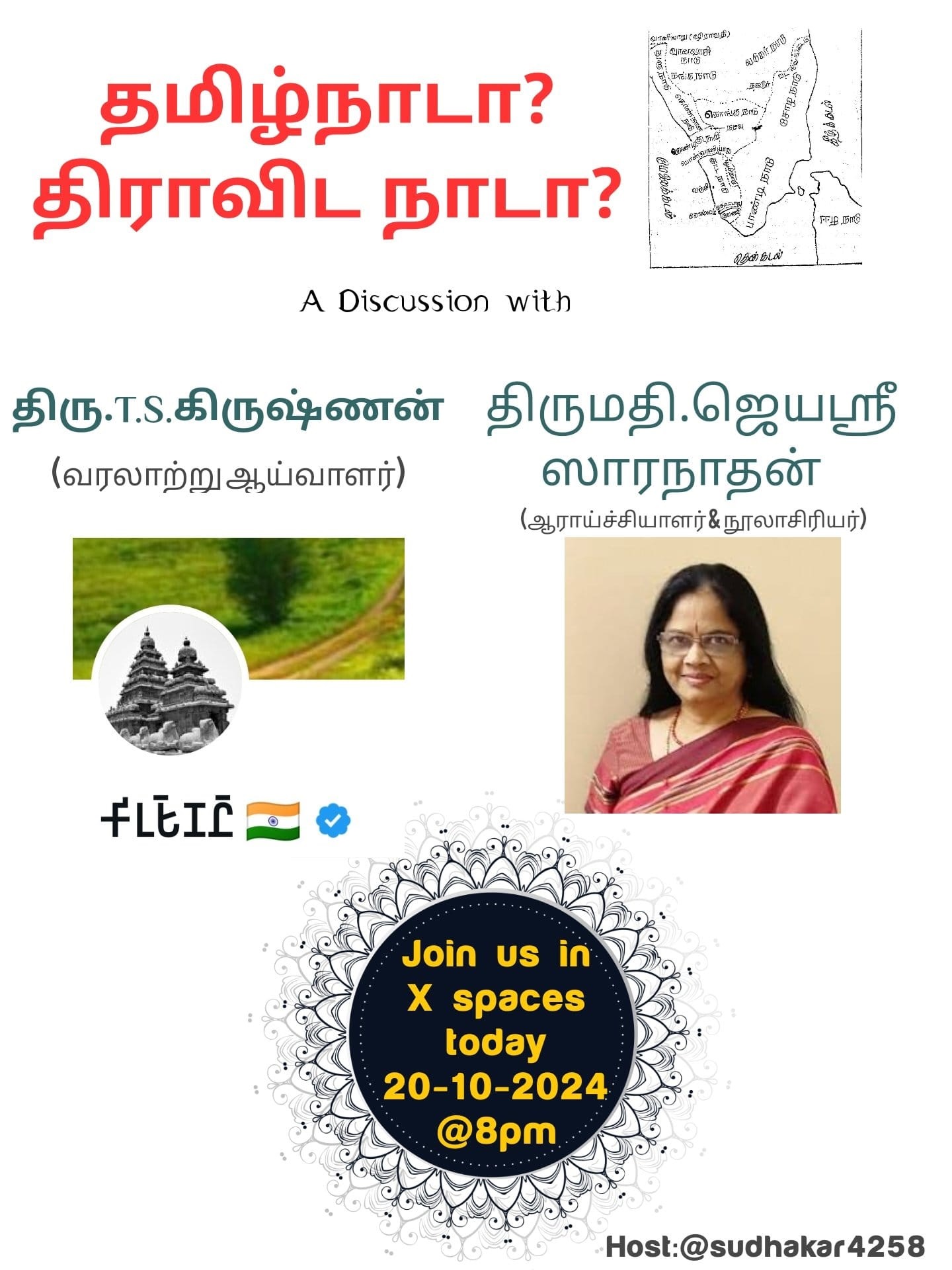
Like a piece of junk food, the talk of 'Dravidam' keeps raising its head from time to time. When it was the talk of the town during Karunanidhi's rule, some 13 years ago, I started a website named "Thamizhan Dravidana" to study the Dravidian concept and had written more than a hundred research articles. Read a sample article here.