Friday, March 5, 2021

Mathematical proof for why the Julian date of the astronomy software can never corroborate the Vedic date of Mahabharata (Supplement to Mahabharata date series -3)

 Previous

Next

Recap:

·         The use of astronomy software to date a long past event such as Mahabharata is unreliable. The main reason is the mismatch between the zodiacal system used in the astronomy simulators and the fixed zodiac of the Indic society for all times in the past.

·         The astronomy softwares use the tropical zodiac or the shifting zodiac along with the moving vernal equinox. This causes the solstices to shift accordingly.

·         This concept is absent in Indic astronomy in which the ayanamsa is calculated and deducted from the tropical degrees to align with the fixed zodiac at zero degree Aries. 

·         At this stage itself the dating research using ANY astronomy simulator is rendered useless.

·         A case study of the year 3067 BCE proposed by Dr. Achar and Dr. Manish Pandit is taken up to show a flawed reference to the vernal equinox at Taurus during Mahabharata, displayed by the astronomy simulator, while it should have been close to the zero point of Aries as per the Indic calendar system.

·         The use of the astrology software simulated with Drik Siddhanta – Lahiri ayanamsa combination to identify the sidereal positions for the various planetary locations picked out from the astronomy simulator for the year 3067 BCE is proved to be a case of flawed methodology with Adhika Masa appearing in the most inappropriate month of Magha around that time. 

From this let me proceed further to show that the date system of the astronomy software doesn’t match with the Indic system of time keeping. Similarly any attempt to deduce the sidereal positions for the dates of the astronomy simulator in the astrology simulator for the Hindu calendar dates cannot produce the correct results.

The calendar system used in the astronomy simulators.

The calendar system used in astronomy and in the astronomy software is different. Unlike the historians, the astronomers depend on arithmetic calculations to arrive at the dates. The date should be easily computable and not requiring counting the number of days of the months and the years and adjustment of the leap years. It should be helpful in simple addition or subtraction in calculating, say, the duration of the cycle of a variable star. For these purposes, the Julian day is found to be helpful and therefore universally used in astronomy applications and in the astronomy softwares.[1]

This day is given as a number with decimal places for the fraction of hours, minutes and seconds remaining in a day, counted from noon to noon in Universal Time or from midnight in Modified Julian days. For civil purposes, the calendric date of the Julian days is given in Julian year. The Julian year was in vogue in the western countries until the Gregorian year was introduced to replace it, though the Julian day system is retained for astronomy purpose. We must know the background of this replacement to understand important features related to the reliability of the astronomy software for dating Mahabharata.

In the western societies, the year was counted from one vernal equinox to another vernal equinox. This is known as a Tropical year. Around 46 BCE, Julius Caesar introduced a calendar named after him as ‘Julian’ that followed the tropical year. It was found out that this year was not of the exact duration of the tropical year and overshot by 11 minutes and 14 seconds.[2]  This resulted in the mismatch of the true tropical position with the calendric tropical year. The Julian calendar accumulated 12.7 days by the time of 1582 CE.

To correct this, the Gregorian calendar was introduced after expunging the accumulated days of the Julian calendar. Ten days were removed but the week day continuity was maintained. From October 4th on Thursday, the next day became October 15 on Friday!  Ten days in the Julian calendar were lost and the sequence of the week days was adjusted arbitrarily from the previous to the next week day to match with the new calendar. This is the first anomaly that one faces while using the Julian calendar system for dating Mahabharata. A number of researches have gone into matching the Julian date with the Gregorian date, but the bottom line is that the loss of week days in the Julian calendar remains. The conversion between the two looks as follows.

For the current time, there is a gap of 12 to 13 days. The week day is synced in both the calendars and synced at all times in past and in future, but we should remember that the natural sequence of the Julian week day is disrupted during the change-over. Two anomalies arise here, (1) the day begins at noon in Universal Time in the Julian calendar but at midnight in the Gregorian calendar at each zone. In the Modified Julian Day System the Julian day starts at midnight at UT. This is in contrast to the Vedic day that starts at local sunrise in India. (2) These calendar dates are just numbers and have no connection to the star positions as in the Vedic system. In all, there are three anomalies if we include the loss of 10 week days.

The Julian days are extrapolated to the past, to the year 4713 BCE (proleptic Julian calendar) which is derived by matching three cycles in use in Europe in the past- the solar cycle, the lunar cycle and the Indiction cycle– each with varying length but synced on Monday noon, January 1 of 4713 BCE. [3] The corresponding date in the Gregorian date was 24th November, 4714 BCE. The week day was the same. It was Monday. The difference was 37 days at that time. 

The conversion between the dates of Gregorian and Julian calendars are perfectly laid now. However the Julian day continues to be the favored system of the astronomers. The reason for this preference is expressed by the International Astronomical Union as follows:  

“Although there are several different kinds of year, the IAU regards a year as a Julian year of 365.25 days (31.5576 million seconds) unless otherwise specified. The IAU also recognises a Julian century of 36,525 days in the fundamental formulas for precession. Other measurements of time such as sidereal, solar and universal time are not suitable for measuring precise intervals of time, since the rate of rotation of Earth, on which they ultimately depend, is variable with respect to the second.” [4] This offers the best explanation for why we cannot take the Julian date for dating Mahabharata.

The Julian year is tropical and it is matched with the tropical year of another calendar, namely Gregorian. Experts have worked on equalizing them by conversion, but where is the research for conversion of the Julian year into the Vedic year which is sidereal?

Sidereal year being longer than the tropical year, how is it possible to claim that the planetary combinations picked out for a Julian date in the astronomy software was the same expressed in Mahabharata that used the sidereal calendar?

It may be argued that the Mahabharata calendar was not sidereal because it used Uttarayana (winter solstice) position for calculating a year. If so, why did Vayu Purana that existed before Mahabharata and which was quoted in Mahabharata for Time computations, express the four units of time of which sidereal is one?[5] The sidereal year was computed even before Mahabharata times and it continued for all times till today.

The Uttarayana computation was for ritual purpose just as the lunar Caitra is taken as year beginning in the current times for rituals. Burgess in his translation of Surya Siddhanta has provided a list of sidereal year duration given in six Siddhantas by giving the difference with the current time.[6]


The error column is not actually errors in computation, as he thinks, but fluctuations in the sidereal year. These fluctuations cause the difference in the length of the year that would further upset the direct match between the Julian tropical and the Vedic sidereal year. These computations must put at rest any doubt on what constituted a year for computation. It was the sidereal year.

Let me take up the more recent text on sidereal year, known as “Veemanatha Pancanga Vākya” in Tamil, written in Kali Year 4968, corresponding to 1867 CE.[7] The length of the year given in this Tamil text is 365 days, 15 Nazhigai (नाडी), 31 Vinadi and 15 Tatparai.

The conversion for this:

Using the conversion, and further converting the into present time scale, the length of the Vedic sidereal year is 365.2586806 days……..(A)

Compare this with the length of the tropical year of the Gregorian and Julian dates.

Gregorian (Tropical)    365.24219878 days …….. (B)[8]

Julian (Tropical) is 11 minutes 14 seconds longer than B = 365.24999971days ………. (C )[9]

The difference between C and B = 0.00780093 days.

The difference of 0.00780093 days per year had caused the Julian year advance by 12.7 days in 1629 years (between 46 BCE and 1582 CE)

It caused a gap of 24 days between now and 3067 BCE promoted as the year of Mahabharata. The gap was 13 days between 4713 BCE and 3067 BCE.  However these differences are just numbers. This is not the case with the Vedic date which is linked with a star and a sign to mark the year beginning.


Now let us compare between Vedic sidereal and Julian tropical that is in use in the simulator.

Vedic Sidereal (A) – Julian Tropical (C) = 0.00868089 days.

Vedic year is longer by 0.00868089 days than the Julian Tropical year.

In how many years, this difference would become 1 day?

115.1955077   Years =1 day

So every 115 to 116 years one Julian day is lagging behind the Vedic year. It must be added to the Julian year to be on par with the Vedic year. 

Calculate the number of days drifted in this way for 3067 BCE (in 5087 years from now)

5087 Years =44.157971 days

The Julian days in the astronomy simulator would be behind the Vedic sidereal day by little more than 44 days for the date 3067 BCE promoted as the date of Mahabharata. 

The drift is higher than this for Mr. Nikesh Oak’s date, 5561BCE that is publicised as scientific. Any date derived from the astronomy simulator suffers from the defect of drifting Julian days.

What I have shown is simple arithmetic.

Only experts can do the conversion accurately by taking into account the noon and mid night beginning of the Julian day and the sunrise time of the Vedic sidereal day.

But what I have shown is that,

·         The planetary combinations in the astronomy software supposed to have been corroborated with the Mahabharata text for the year 3067 BCE cannot match with the true positions in the Vedic year corresponding to that date.

·         The application of the Julian year in Jhora astrology software to generate the sidereal positions of the Vedic Year cannot produce the true positions because in the absence of the conversion of the Julian to Vedic sidereal, the day and the planetary combinations shown in the simulator is not the true date corresponding to the Julian date.

To cross-check this mismatch between the Vedic sidereal year and the Julian date of the astronomy software, let me take up the 1st day of the Julian period, i.e. January 1, 4713 BCE that occurred on Monday. The astrology simulator must show Monday on that date for noon at Universal Time. I checked it for the year 4713 BCE and also 4712 BCE (one year less) as was done by the 3067 researchers. Drik- Lahiri is taken up as done by them.

Figure 26: First day of the Julian calendar

Figure 26 shows Friday, NOT Monday. The solar and lunar calendars were supposed to have begun on that date. They don’t appear so. Figure 27 shows the features for one year less.

Figure 27: Julian Calendar with one day less

The week day and the solar- lunar calendars do not match with the proleptic Julian first year.

Now let me also show how it appears for the Gregorian settings. The conversion is as follows:

The simulation for 24th November, 4714 BCE is as follows:

Figure 28: First day of the Julian calendar in Gregorian settings

It was Friday and the solar and lunar months did not begin on this date.

The following Figure is generated for one year less.
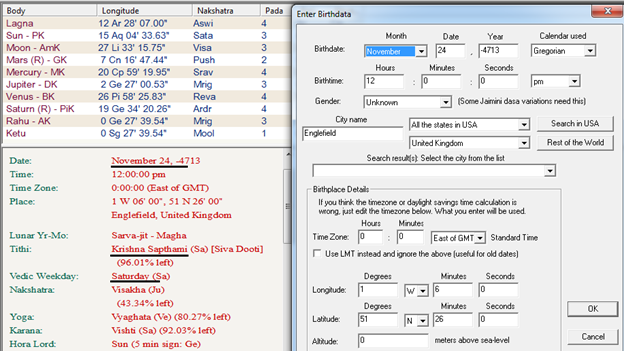
Figure 29: One day less for the first day in Gregorian calendar

Once again mismatch in all respects.

This makes it very clear that the Julian date taken up from the astronomy software does not tally with the Vedic year of the astrology software.

Conversion is a very basic requirement when we pick out a date from one calendar and try to match it with another calendar.

This major defect started from Prof. K. Srinivasa Raghavan whose work was embraced without any critical study. He used Julian days for calculating the dates of Mahabharata. He overlooked the fact that the Vedic day is not of the same length as the Julian day - a crucial point and a game- changer in the search for the true date of Mahabharata war. This was similar to Dr. S. Balakrishnan’s failure to recognize that a tithi is different from a solar day. The entire research group of today followed these two persons and lost their way to reach the goal.

In any research in science or engineering, the veracity of the methods and methodology (use of software) would be meticulously tested and assessed before embarking on the research. Here in dating research of Mahabharata (and Ramayana too) this minimum requirement is not at all adhered to. Without even knowing whether the astronomy software is suitable for testing the planetary positions given in the Itihasas, too many people are just picking out an astronomy software and are claiming that they have “found out” the date!! Without knowing this major limitation of the softwares, people are picking out some date – none of which tally with the traditional date of Mahabharata at 3136 BCE! The reading public should know this limitation of every dating research done using the astronomy software. 

With this we are moving on to the 3rd issue on how the calculation of the position of the planets and the stars in the astronomy software is not the same as in Vedic astrology by taking up the year 5561 BCE proposed by Mr.Nilesh Oak.  

(To be continued)

Wednesday, March 3, 2021

Limitations of the astronomy simulators for dating the Indic past – 3067 BCE as case study (Supplement to Mahabharata date series -2)

Previous

Next

Today the methodology followed by the researchers to find out the date of Mahabharata is to make a list of astronomy references given in the Mahabharata text, including the eclipses –without deciphering whether the Sanskrit verses do refer to an eclipse or not; choose a millennium range as one thinks right and try to locate the twin eclipses or three eclipses in that region to zero in on certain dates; then find out the date that is more closer to the planetary combinations. All these are checked in the astronomy simulators that use concepts different from the Vedic way of calculation of the planetary positions. The meticulous calculation of the ayanamsa and the adjustment of the same to stick to the zero point of Aries is completely absent in all these astronomy softwares. The mismatch can be summarized under three headings in the context of dating Mahabharata. 

(1) The division of the zodiac is not the same as in Vedic astrology.

(2) The calendar system used in the simulators for a remote past raises more questions than it could answer.

(3) The calculation of the location of the planets and the stars differ greatly.

The division of the zodiac (tropical) is taken up in this part and checked with the date 3067 BCE, earlier suggested by four scholars including Prof. Srinivasa Raghavan as the date of Mahabharata war, later proposed by Prof. Narahari Achar and now promoted by Dr. Manish Pandit.

The division of the zodiac.

The zodiac of the western astronomy and western software doesn’t start from the zero point of Aries where the star Aswini begins, but keeps shifting backward (as of today) along with the moving vernal equinox. The first point of the shifting vernal equinox is taken as the first point of Aries. Figure 16 shows the zodiac with three points, A, B and C. A represents zero degree Aries, the beginning point of the zodiac (sidereal) identified by the Vedic society. Presently the sun has moved away from this point to B located approximately at 6 degree Pisces. This displacement is approximately 24 degrees to the left. This is the approximate ayanamsa of the current time. Different systems of ayanamsa hover around this number.

Figure 16: Vernal equinox as of today

Western science treats the current point (B) as the beginning of the zodiac, i.e. the zero degree point of Aries. In other words the zodiac starts from B as per western astronomy. What is Pisces in Vedic astronomy is Aries in western astronomy.

Since the sun is seen to move leftward, the beginning point of the zodiac keeps shifting with the shifting sun as per western astronomy. When the sun shifts to the point C (Aquarius) then that would be taken as the beginning point of the zodiac, namely Aries. What is Aquarius in Vedic astronomy will be then known as Aries in western astronomy

Vedic astronomy never followed this system of the west. It has always held on to the zero degree Aries by applying the ayanamsa. At any time in the past, including the time of the Mahabharata, the planetary longitudes were constantly adjusted this way.

Today with the loss of continuity of the Vedic astronomy- astrology schools, we pick out the tropical longitudes from the western ephemeris (used in western softwares) and deduct the ayanamsa of today. The horoscopes used in Hindu astrology are cast in this way only.

Tropical planetary positions not used in the Indic system

To show how the tropical longitudes change in the Indic system, let me produce the planetary positions on 21st March 2021 (tropical vernal equinox) from Jhora astrology software for the western model (Tropical zodiac) and the Indic model using Lahiri ayanamsa. (Figure 17)

Figure 17: Comparison between sidereal (Indic) zodiac and Tropical zodiac (western)

One can compare the data  in Figure 17 for the differences. The data on the left is prepared by incorporating Lahiri ayanamsa. The data on the right is based on western concept of tropical or shifting zodiac where the ayanamsa will always be zero (ayanamsa added / sayana). On 21st March the sun would be at the 7th degree of Pisces but that would be treated as zero degree Aries in western astronomy. The figure shows the sidereal points for the tropical zodiac, but in reality western astronomy does not link the planets with the stars at their background. In other words, people using the astronomy software for dating Mahabharata would not know the star dispositors of the planets which are very essential in Vedic astronomy.

For the same date, time and location taken for both the models, the tithi remains the same, but the star transited by the moon is different; and the planetary longitudes also have differed greatly.

·         The tithi doesn’t change because it is unrelated to the background of the sun’s movement in the sky. It is calculated as 1/30th part of the lunar orbit from one conjunction of the moon with the sun to another.

·         The star had changed because it is observed in the background of the solar system as the moon crosses a particular part of the sky. The zodiac being enumerated from the 6th degree of Pieces in western astronomy, the star at the background of the moon is pushed forward accordingly.

·         Coming to the planetary degrees, look at the huge difference between the two systems. It is because in the Vedic system, the ayanamsa value of 24-08-15.05 is straightaway deducted from the tropical positions of the planets.

·         Lahiri ayanamsa is used here. Until the time the Indians were observing the planetary positions by themselves, there was no Lahiri or Raman or Pushyapaksha or any other ayanamsa. But today with everyone depending on the planetary tables (ephemeris) prepared by the western sources such as the NASA the ayanamsa value is needed to be deducted as shown in Figure 17. 

What we are shown in the astronomy simulators for the Mahabharata time 5000 years ago or 7000 years ago are just run-away positions of the planets enumerated from the vernal equinoctial location of those times, and not corrected to the fixed vernal equinox at zero Aries of the Vedic system.

As a result along with the tropical equinoxes, the signs and the solstices also shift continuously in western astronomy. Those who use the astronomy software seem to have ignored this mis-match with the Indic calendar. To cite an example, let me quote from Prof. Narahari Achar’s monograph on the “Date of the Mahabharata war using Planetarium software[1]

The rejection of a date or endorsement of a date for Mahabharata is done on the basis of the tropical equinoxes of the astronomy software. If the tropical positions are accepted, why should we expunge the ayanamsa value from that? Why do we continue to reject the current tropical equinox at Uttara Bhadrapada with many stalwarts having labored to derive the correct ayanamsa for the current time?

One may say that this is for astrological purpose. In the Vedic system astrology and astronomy are not working at cross purposes. Astronomy is Siddhanta that devises means and methods to find out the ayanamsa by the observance of the shadow of the gnomon – for application in astrology. Both astronomy and astrology work on the same celestial entities with astronomy providing the mathematical derivation of the positions of these celestial entities (where ayanamsa gains relevance) and  astrology, devising the impact of those celestial entities on man and mankind from the positions identified by astronomy.

Figure 18 shows the classification of the Jyothisha system incorporated in Narada samhita, Brihat samhita and encapsulated in Prasna Marga.[2]

Figure 18: Branches of Jyothisha

The Siddhanta section having Gola and Ganita is astronomy. This is part and parcel of the overall compendium of astrology. Without Siddhanta (of Jyothisha), Hora cannot exist; without Hora there is no use for Siddhanta. Samhita also depends on Siddhantic derivations for zodiacal and asterismal concepts. If Siddhanta is theory, Hora and Samhita are application part of it. When we say Siddhanta, people immediately think it is Surya Siddhanta. There are many Siddhantas and all of them can be classified into three, depending upon the utility. 

(1) Siddhantas that calculate Time from the beginning of Kalpa; the 18 Siddhantas including Surya Siddhanta come under this category.

(2) Tantra Siddhantas that offer calculation of Time from the nearest Yuga; e.g Aryabhatiya.

(3) Karana Siddhantas that offer methods to calculate time from the nearest Shaka. Many Karana Siddhantas were composed in the last 1500 years after the equinox crossed the zero point of Aries. Laghumānasa by Manjula, Rajamrgānka of King Bhoja and Karanakutuhala of Bhaskara II are some examples of Karana Siddhanta.

Each Karana text starts with an epoch of its own that comes within a Shaka era. The purpose of these texts is to offer the corrected tables of the planetary longitudes and time factors to be of use to the Pancanga makers and the astrologers. It is easy to calculate from the nearest time than from Kalpa or Kali Yuga. More importantly the ayanamsa values and the planetary positions are updated for the nearest time under consideration. The very existence of many karana texts shows that the Siddhantins were constantly updating the planetary positions and the ayanamsa. Today western scientists do concede that planetary positions are subject to variations due to many causes. This was already known to Indic Siddhantins who were well equpied with methods to get the accurate positons.

The Vedanga Jyothisha authored sage Lagadha is similar to Karana Siddhanta in giving the time factors for a particular period when the equinox reached its maximum eastern limit at the first quarter (pada) of Krittika in Mesha (Aries). The time of Vishuva (vernal equinox) given in this text for the 3rd year of the 5 year Yuga (middle of the Yuga) is the same as what is found in Vayu Purana that was in existence before Mahabharata.[3]

The Vishuva occurred on the Full moon of Vaishakha month when the sun was at the 1st pada of Krittika in Mesha, as per Rig Vedanga Jyothisha.[4] Vayu Puarana also recognises Vishuva when the sun was in the 1st pada of Krittika and (Full) Moon at the 4th pada of Vishakha – the day of Full moon.[5] Vayu Purana also makes a significant statement that the equinox is known from the position of the sun and moon. (Figure 19). In the 5-year Yuga of Mahabharata the true position of the winter solstice (Uttarayana)  was recognized only in the first year and that was marked at a time, the moon joined the sun. In subsequent years, the Uttarayana did not start on the same conjunction. It repeated only on the 6th year which was the 1st year of the next Yuga. So the solstice of Mahabharata time is not what the astronomy simualtor shows; this is some other calculation.  

Figure 19: Vayu Purana on Vernal equinox

Two texts – Lagadha Jyothsiha and Vayu Purana – separated in time, give the same position of the vernal equinox. How was this possible? What does this convey? Should we say in Oakian style that Vayu Purana was composed 26000 years before Lagadha Jyothisha or deduce that Vayu Purana referred to the maximum limit of the equinoctial limit in any cycle of the to and fro oscillation for 54 degrees or that Vayu Purana was composed at that equinoctial limit in the previous cycle of the oscillation?  When we attempt to date Lagadha Jyothisha, using the astronomy software, why not date the equinox given in Vayu Purana using the same software? Only then we will know that there is a big slip between the astronomy knowledge given by the astronomy softwares and the Indic knowledge written in Siddhantas and Puranas directly and indirectly. Table 13 in Part 1 listing down the duration of the cycle around 7200 years cannot be brushed  away.  

Prof. Achar had also stated that the vernal equinox was near Rohini around 3200 BC. This is just a century earlier than the Kali Yuga begin-date when Krishna left this world. Kali Yuga date was marked by all the planets except Rahu congregating at the beginning of Aries. This date can never be simulated in any astronomy software, because simulators follow continuous precession. The last time the vernal equinox crossed zero Aries was in 499 CE. The previous conjunction of the vernal equinox at the same zero Aries point will appear 24k or 26k years ago in the astronomy simulator. But this conjunction happened 3600 years prior to 499 CE (3101BCE) is what Aryabhatta has written. 

Just think about a model in which the Kali Yuga occurred at zero degree Aries, before the 499 CE mark in the same zero degree Aries (when Aryabhata was 23 years old). It would appear as shown in Figure 12 in Part 1, reproduced in Figure 20 below.

Figure 20: Equinox appearing at Zero Aries at Kali Yuga beginning

This model, not known to the westerners who designed the software, can never be detected in any astronomy software. Their model developed from their knowledge of equinoctial movement in the last few centuries, shows Kali Yuga in Taurus and the equinox of the Mahabharata time in Taurus. (Figure 21) For Mr. Nilesh Oak's date of 5561 BCE, it goes out of the frame in Figure 21. It starts in Gemini - that is, tropical Aries in Gemini is picked out as the starting point of Aries for Oak's Mahabharata. 

Figure 21: Equinox of Mahabharata in Taurus in the astronomy software

The astronomy simulator would show the vernal equinox at Rohini for 3067 BCE. This can be seen in a simulation tweeted by Dr. Manish Pandit from Cybersky simulator in support of the year 3067 BCE for Mahabharata proposed by Prof. Achar. The screenshot shows summer solstice near Purva Phalguni star. (Figure 22)

Figure 22: Summer solstice (Dakshinayana) in Purva Phalguni

The three stars of Leo, namely Magha, Purva Phalguni and Uttara Phalguni are shown by arrow marks in Figure 22. Leo ends with the 1st pada of Uttara Phalguni. It is seen that the summer solstice (underlined with dotted white line) marked at 90 degrees was at Purva Phalguni in 3067 BCE. It is at the middle of the sign Leo in the Vedic system of the zodiac.

One can trace the beginning the vernal equinox from this 90 degree point in the map (Fig 22) through the previous degrees. The 60 degree point (towards the right corner on the ecliptic) is shown by a white arrow mark. Further down there is 30 degree mark in Gemini (not seen in the Figure) and 0 degree beginning at the vernal equinoctial point of that time in Taurus! With ninety degrees separating the summer solstice and the vernal equinox, the location of the vernal equinox on 3067 BCE is found at the middle of Taurus where Rohini is seen.

Have we ever heard of the vernal equinox starting at Taurus?

Is there any text of the Vedic culture stating that Vishuva (vernal equinox) started at Rishabha?

All the Puranas have a separate chapter on cosmology and time, but why none of them state anything other than the limited extent of the vernal equinox around zero Aries and not going beyond Krittika in Aries?

Have we ever come across a Vedic reference to Dakshinayana starting at Purva Phalguni? We claim thousands of years for Vedic past, but why is there no mention of the summer solstice beyond the sign cancer?

The only time we read about Summer solstice starting beyond the sign Cancer is from Maitrayaniya Upanishad which recalls an old memory of Dakshinayana starting at the star Magha by stating that “It has been said elsewhere”.[6] But then such an alignment was possible when Abhijit was part of the zodiac and Krittika was not. The olden and original zodiac had Abhijit and not Krittika. During Skanda’s time Abhijit was dropped and Krittika was accepted as the star of the zodiac. In the original zodiac of the old, the maximum limit of the vernal equinox was Rohini and that of Dakshinayana was the star Magha.[7] (Figure 23)

Figure 23: Summer solstice at Magha when Abhijit was part of the zodiac

Always the tropical vernal equinox moved only within two signs - Pisces and Aries. There is a Tamil adage continuing to be in vogue, stating that one should not see “Meena or Mesha” - in an obvious reference to the equinox anywhere between these two signs but never outside them.[8]

Back to our discourse, the tropical solstices and equinoxes of these softwares never match with the Indic system of the same. It may be argued that the dates picked out from the astronomy software can be fed into astrology software to get the Indic calendric dates – but not possible to get the solstices and equinoxes.  Till date everyone using the astronomy software to date Mahabharata is showing the solstices, only from the tropical locations given in the software. Date of Krishna’s mission and Bhishma’s exit are shown in tropical locations. How could the end of the sharad season of the 5-year Yuga of Mahabharata be located near the tropical autumn equinox?  How could the Uttarayana at Magha Shukla Ashtami be simulated in the astronomy software?

The backers of the Year 3067 BCE offer a way out. They think that they can simulate the date in the astrology software. They use the current Lahiri ayanamsa to show the sidereal positions of the planets they located in the astronomy software, though they can never establish the solstices and the equinoxes as used by the Mahabharata people in the 5 year Yuga system.

The approximated ayanamsa fails the test of reliability for Mahabharata at 3067 BCE

They use the current Lahiri ayanamsa approximated to 3067 BCE with the result the ayanamsa is at the range of 47 degrees – a reading never acceptable to Vedic calendar. The problem is we want to use the Vedic calendric system for Mahabharata date, but we won’t adhere to the Vedic calendric rules of the ayanamsa.

Along with the approximated Drik Siddhanta values of the tropical position of the planets as observed by the modern planetariums, the approximated ayanamsa value is added to get the positions of the planets as per Vedic-Hindu system. There is a test of the reliability for this methodology for as long a time as 5000 years ago when Mahabharata occurred. Let me check it after explaining it.

Indic people must be aware of the concept of Adhika masa and Kshaya masa in the Vedic calendar system. The Adhika Masa concept was a crucial factor in determining the duration of the exile of the Pandavas in Mahabharata. It was part of the 5-year Yuga system of the Mahabharata calendar.

When there is no solar ingress into a sign (Sankaranti), within a lunar month, that lunar month is treated as an Adhika masa. This could occur in any month between Phalguna and Asvayuja once in two to three years. When there are two solar Sankaramana-s within a lunar month, that solar month is known as a Kshaya masa. This is caused by the faster movement of the earth in the months between Kartika and Magha when the earth is passing the perihelion of its orbit around the sun. As a result the solar month passes quickly resulting in Kshaya masa. This happens once in 149 years in one of the months from Kartika to Magha. Adhika Masa cannot happen in these months, particularly in Margashira, Pushya and Magha. The Adhika masa not occurring in these months is the test of reliability of the Drik-Lahiri combination chosen by 3067 BCE promoters.

This nature’s law is violated when we use Lahiri ayanamsa to a distant past as 5000 years ago. Figure 24 shows Adhika masa in the month of Magha in Shubha-krit year corresponding to the Gregorian date of 3138 BCE! Can this happen in reality?

Figure 24: Adhika Magha – an impossible event in Nature

Figure 24 demonstrates that whatever formula that had gone into calculating the precession and the coordinate systems to be applicable to a distant past (and close to the Mahabharata date) had just gone beyond realistic limits. From this one can judge the reliability of the outcome for the year 3067 BCE, coming close to this date by 71 years for this combination of Drik-Lahiri.

Further cross-check with the Julian date gives a similar result of Adhika Magha. Figure 25 is simulated to the Julian calendar that is used in all the astronomy simulators. It also shows Adhika Magha in 3138 BCE.

Figure 25: Adhika Magha in Julian calendar date

Adhika masa in Magha is the single most proof to reject the use of Drik- Lahiri for dating Mahabharata. The adhika masa is ingrained with the relative motion of the sun and the moon from the geo-centric view. It is also defined by the ecliptic coordinates at that time and the motion of the moon whose orbital nodes are crucial for determining the eclipses. They have all gone topsy-turvy for the time close to 3067 BCE is the fact glaring at us. Therefore the Pancanga features (year, month, paksha –tithi, star and week-day) and the sidereal positions of the planets for 3067 BCE simulated by the Drik-Lahiri combination coming close to this Adhika Magha by 71 years are no longer worth considering.

Mahabharata war occurred close to Kali Yuga date that is referenced in numerous inscriptions. The tropical vernal equinox at zero degree Aries at that time should ring the bell to the researcher that the ayanamsa was zero at that time. The Lahiri ayanamsa at 312-54-21-45 for 3067 BCE highlights the inevitability of doing a ground study of the Indic system before starting the research. Mahabharata dating research is not like a science research where there are many theories already available and the researcher is working on improvising them or looking for a new break-through idea from them. The date is available, embedded in the text itself, detectable by using the exact ayanamsa of the Mahabharata time, but with almost everyone picking up the tropical zodiac of the astronomy simulator we are seeing a plethora of dates– none of them matching with the true date of Mahabharata - but making a mockery of the Vedic calendric system in use in Mahabharata.

There is another issue here. The date picked out from the astronomy simulator is from a calendar that is different from the one used in the astrology software. How far is it reliable? We will check it in  the next part of this short series.

 (To be continued)

Click here to know how the calendar of Mahabharata time was deduced. It looked as follows and not as seen in the astronomy simulator.


This is e-mailed to Prof. Narahari Achar and Sri. P.V.R.Narasimha Rao, the maker of Jhora software. 


[1] B.N.Narahari Achar, (2014) “Date of the Mahabharata war using Planetarium software”(pdf) p.88

[2] Prasna Marga: Ch 1- V. 5-8

[3] Mahabharata: 3-189-14

[4] R-VJ: verse 33 from ‘Vedanga Jyothisha by Lagadha’, translated by T.S.Kuppanna Sastry, p. 47

[6] Maitrayaniya Upanishad 6-14

[7] Dr. Jayasree Saranathan, “Myth of ‘The Epoch of Arundhati’ of Nilesh Nilkanth oak’, Chapter 13. P.389. https://www.academia.edu/44757153/Myth_of_The_Epoch_of_Arundhati_of_Nilesh_Nilkanth_Oak

[8] ‘Meena Mesham paarkka-k koodaadhu’