This blog aims at bringing out the past glory and history of India, Hinduism and its forgotten values and wisdom. This is not copyrighted so as to reach genuine seekers of these information. Its my prayer that only genuine seekers - and not vandals & plagiarists - come to this site.
‘Vakri’ is a word that often troubles this
Mahabharata researcher. Since he never thought that learning astrology terms
would help in understanding the astronomy terms of Mahabharata, we are entertained
with a new a discovery of the definition of Vakri, through ‘Voyager- Simulation Nyaya’.
He gives the list of findings on Vakri he made through this Nyaya in the 4th
chapter on Mahabharata astronomy[1].
Vakri is generally translated as ‘retrograde motion’. But Oak found a difference between Vakri and
retrogression through the Voyager- Simulation Nyaya and proposes that
the Mahabharata uses the two terms in different meanings. After working on the
vakri of different planets with the aid
of this Nyaya, he came to the conclusion that “Mahabharata
astronomers referred to
oblique crossing of the ecliptic by a planet as ‘vakri’ motion while the
true retrograde motion of a planet was described as being steady (dhruva or
sthayi), or travelling in reverse (apasavya) direction.”[2]
For a reader confused with this distinction between vakri
and retrograde motion, a solution is available in his blog as follows: [3]
Anticipating what the reader would ask on reading
this, he continues to write as follows in the same blog post.
He differentiates the two movements – Vakri and
retrograde - of which the definition of the latter continues to elude him. As
one who has confessed in the very beginning of his book that his approach is
‘piecemeal’[4]
he has solved the problem of Vakri for now and postponed to a future research
the concept of ‘retrograde motion’ given in Mahabharata.
With this piecemeal discovery Nilesh Oak goes on to
locate the vakri planet and the retrograde planet in the simulator and claims
victory that he had correctly found out the date of that observation.
If his definition of vakri is true, then Mars cannot
be seen making oblique crossing of the ecliptic this year –i.e. 2019 – the year
of writing this critique, for the simple reason that Mars does not have vakri
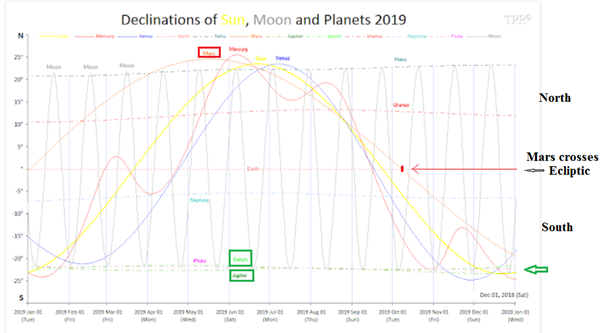
motion, or retrograde motion throughout 2019. But what does the declination
graph for 2019 show? It shows Mars crossing the ecliptic from north to south in
mid October 2019. Similarly the outer planets such as Jupiter and Saturn are in
vakri motion in the middle of the year, but both are seen at the southern most
part of the ecliptic throughout the year with no obliquity in their motion. The
following graph testifies this.[5]
Mars is marked within red box while Jupiter and
Saturn are marked inside green in the above graph. A no-vakri Mars is crossing
the ecliptic obliquely while there is no change in the path of Saturn and
Jupiter that are in vakri motion in the middle part of the year.
A simple cross-checking of the current motion of these planets offers the best
test of his hypothesis on vakri motion, but he has omitted this
important step. Even before we could plunge into his Epoch of Arundhati and
planetary alignments in support of his date, we are finding him make Himalayan
blunders in understanding the terms of Mahabharata astronomy. One can then imagine
the veracity of the findings coming out of this flawed use of the term vakri to
locating a date in his simulator.
(4) Experiment numbered 13:
Vakri’ motion of Mars.[6]
(Mahabharata reference No: 11, 13, 14 in his book)
In the previous instances quoted on the
manipulations done by Nilesh Oak to prove his date, we faulted him for
neglecting to define the terms in the verses. Here in this experiment he
attempts to define the term ‘Vakri’ in the verses on Mars. It was well
established earlier how Nilesh Oak demonstrated his utter lack of understanding
of ‘Vakri’.In this experiment he
describes how he derived the meaning of the term Vakri through DVA – Direct
Visual Astronomy of the Simulator.
Nilesh Oak hopes to clinch something big in his
discovery of the meaning of Vakri, comparable with Kepler. He says,[7]
“There is indeed something intriguing about Mars.
Small discrepancy (between prediction and actual observation) in the
measurement of Mars led Kepler to his marvellous theory of elliptical orbits of
planets. Intriguing descriptions of Mars in the Mahabharata text and my
explanation provide high degree of corroboration to the proposed year of 5561
B.C.”
Oak has indeed made a break-through invention of
Mars spending nearly 6 months in retrogression in Chitra and Swati before it
turned forward.[8]
This is against the current scientific knowledge of Mars in retrogression that
is possible for only 80 days at a stretch. All glory to
Voyager simulator that enabled him to see this through DVA.
·Nilesh Oak can notify the developers of
Voyager Simulator of this discovery to take his name forward for recognition.
·Oak can also notify them of his
innovative ways of deriving meaning for a Sanskrit word like ‘vakri’ and the
English word ‘retrogression’ by means of DVA so that they can use his name and
innovation as publicity material to promote their product.
·But Nilesh Oak must be careful not to
take his discovery and innovation to the notice of an astronomer to avoid
getting his book tossed into a dustbin. No astronomer would accept his
explanation without first establishing them conceptually and mathematically.
Sadly Nilesh Oak’s book is a series of ideas never
established conceptually or mathematically but ‘seen’ and ‘proven’ in the DVA
of the Voyager Simulator.
Muhurta[1]
is a basic unit of time which continues to be vigorously followed even today. A
solar day has 30 Muhurtas that is split into day-time and night time Muhurtas
of 15 each. The nature of each Muhurta (nature of time) is revealed by the
etymology of the name of the Muhurta. That this has been perfected in
Mahabharata times is known from the verse on Krishna starting off for the peace
talk in Maitri Muhurta where Maitri means friendship.
As a Mahabharata researcher Nilesh Oak is expected
to do his homework on terms such as this pertaining to Mahabharata astronomy.
But from what he says it is obvious that he has not acquainted himself with the
fundamentals of Mahabharata astronomy. He thinks by possessing Voyager software
and learning to run it – which any kid can do- he can decipher the astronomy
terms of Mahabharata and fix up the date of Mahabharata War based on it.
“Krishna left Upaplavya, early morning, on 31st
August... I do not know the significance of ‘Maitri Muhurta’, however if
it refers to ‘Maitri’ nakshatra being on the eastern horizon, then Anuradha
(Maitri) nakshatra was on the eastern horizon around 7:30 AM.”
His honesty in accepting that he doesn’t know the
significance of the term cannot be appreciated in a research. What should a
genuine researcher do when confronted with terms unknown to him? He/she must
first develop a data base of all the unknown terms in the text and gather
information about them. This must be done before embarking on the research.
But Nilesh Oak is someone who thinks that scientific
methodology means using only the software and does not realize that “history is a science in the method and manner in which it
studies the evidence and ascertains the facts.”[3]By
his failure to approach the issue in a scientific manner of collecting
information on fundamental concepts (there are many), he is giving wrong
information that Krishna started off “early morning” and makes a ridiculous
derivation of time from the Voyager by bungling up Maitri Muhurta with Anuradha
nakshatra.
The following is the template used by him. When people like me start questioning his version point by point this is what he uses. The most recent to get this treatment was Dr S. Kalyanaraman.
Step 1- Claiming that he is ready for uncut, unedited live debate, but the opponent ran away.
Step 2 - Calling us to come on debate in sangam talks, jaipur dialogues, followed by the official handles of those sites calling for debate, at times abusing us. This proves that they are all his men. Step 3- If it doesn't work, he will take up jalpa, vitanda talk
Step 4- He will show some slides with material challenged by us, but promote them by adding jargon from Nyaya concepts
Step 5 - Flaunt a page showing his books that his reply is there, notwithstanding the fact that the book has been challenged
Step 6 - Block us or mute the tweets.
(In my case he asked me to unfollow him if I don't accept his version. It was he who asked me to challenge his book (those tweets are there in the open. I have not deleted, dont know about his) and I took up the challenge and released the book. Once the book was released, he started the attack on me instead of responding to my critique. In academia we write critiques and counter critiques, but know that he is not an academician) Step 7 - Now enters his accomplice with her one and only simulated movement of A-V which no man can see but can be seen in the simulator
Step 8- Then starts a barrage of re-tweets and likes for Oak's and his accomplice's tweets with some of them abusing us. Debate successfully over. Now in my case two more steps.Step 9- People like yourself knowing nothing of all these start asking me 'why not you debate' When the very date is wrong, what is there to debate? What would you tell a person who 'researched' to 'find out 'that India got Independence in 1990? Same here with his Mbh date.Step 10 - Abuse my Phd background. Step 11- Runaway from defending his 'theory' critiqued by me and turn the tables saying that I ran away.Now start from Step 1Waiting to see if any more to be added in this template. //UPDATE on 12th sep 2020. (Step 11 added)Read Nilesh Oak's response to why he didn't reply to my critique.
Check this link to read his tweet on why he didn't rebut, or in other words, didn't defend his 'theory' as against my critique. First he wrote, " I have read the book. It is utterly nonsensical. "On being reminded there are no rebuttals from him he wrote, "Rebuttals are done for things that are either worthy of critique or have strategic value. This one, at least at this time, has neither.
Let there be more tweets, videos made by her (she stopped at only 6 or 8, very sad) more folks reading that book, better it is."So he has read my book that critiques his entire book, but didn't defend his book.The obvious reason is he cannot!It is he who had run away. He ran away without defending his book but abuses me that I ran away from the debate. If he doesn't find anything worthy of critique why does he call me for debate and claim that I ran away.So his template is now complete.Step 11- Runaway from defending his 'theory' critiqued by me and turn the tables saying that I ran away.Now start from Step 1// End of update.At times a few people enter the 'debate' with him. He will then say "I give my presentation, you give your presentation, we agree to disagree" The moderator will be Oak's man, mostly leftist turned rightist who openly claims that he supports so and so because that so and so supported him.
Once the debate is over, it will be cut and released, but Oak would begin his abuse talk on the debater.
At times the video will never see the light of the day, like it happened for Jijith Nadumuri., because Jijith did a clean job of sweeping him out.So what is happening?
It is an Eco-system promoted by him and funded by himself and NRIs.
Nilesh Oak is primarily a marketing man and he is able to sell even a bad product, that is what he is doing.
Nothing can be done about him.Delhi based senior author and historian wondered why so many 'Indic" sites are there, most of them promoting outside-India based people who have no basis in Indic texts and suddenly becoming Mahabharata researchers.
She suspects some terrible reasons.
I suspect some destabilizing design by Western AIT-ians having intruded by funding and promoting unscientific dates of Oak of the two Itihasas so that when they gain wider acceptance among Indians, they will axe us with scientific facts, like how Oak's Ramayana could not have taken place when Ice Age was still running and how his Mahabharata date is wrong because A-V theory is wrong as science has established them to be on gravitational coupling of a cycle of 7,50,000 years! So you Indians have no scientific acumen, you are all living in mythical world promoting mythical Rama and Krishna.
Game over. Oak has foolishly played his part.
We will come back to square one.
People like you are paving way for this end by cheering up this hoax.
My case is a warning to anyone who critiques Oak's 'research.'
SM Goondaism is in full glare of everyone. No Indic researcher is ready to face it.
That I stood up is making him target me, instead of my book.
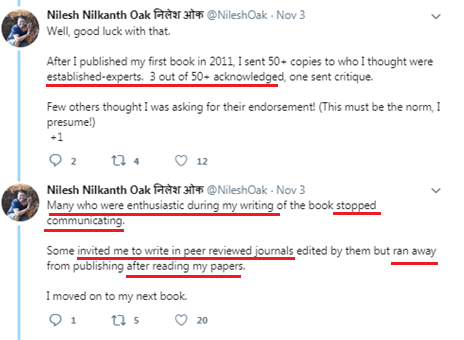
Self confession of Nilesh Oak that initially those who were willing to publish his book 'ran away' after reading his papers and book - tweeted in Nov 2019
************
Update on 25th October 2020
To show the readers the quality of the person hiding in the garb of a 'researcher':-
Nilesh Oak read my tweet about the above blog and acknowledged a tweeple with a Namaste. That was on 24th October.
On 25th October, he tweeted as though he was not aware of my tweet until someone brought it to his notice and he wrote the following. Look at what he has written. Have we ever seen any genuine researcher write like this? No reply to my book, but only this kind of abuses.
Here is a sample that recently appeared in my notification.
For this Update more abuses are going to be flung at me.
My response is going to be serial publication of excerpts from my book to caution people to know what he has written. If needed I will open my ebook for free.
UPDATE continues
As expected abuses are coming, but I want to highlight one among them.
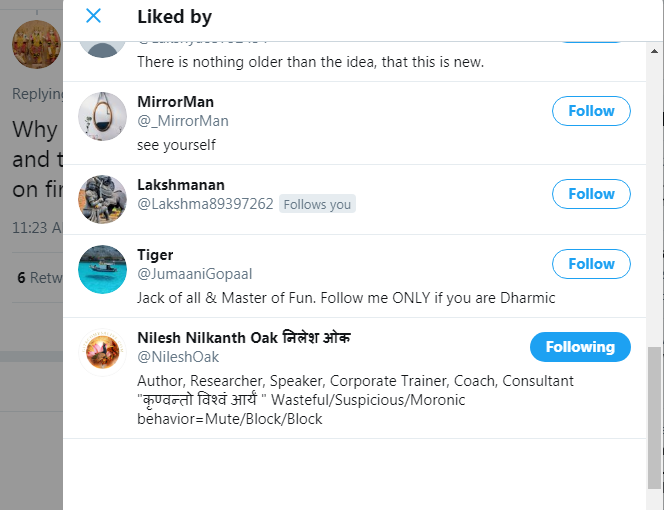
The abuser had created the twitter ID only in September 2020. Not following anyone, but made a comment, 'my saree on fire'. Any idea who was the first one to like it?
And this person is from ex-Pakistani army, says his profile.
*************
UPDATE on 1st November 2020
This update is necessitated by the detection of a pattern in troll culture.
The moment I tweet my article or someone's, critiquing Nilesh Oak's date of Mahabharata, immediately minimum three persons retaliate with the same, familiar words and ideas,
why I ran away from debating,
why I am not debating
debate at Jaipur Dialogues as though they are their agents
I should know / establish the 'Shashtrartha' or the debating 'tradition' of our country.
Interesting part is all of them happen to be following my twitter handle.
Why should someone follow someone's handle?
We think it is to know or learn what that handle says.
Since I generally write and tweet heavy, intellectual stuff, I find limited followers only, but those keen on knowing the topics I write.
If these trolling tweeples had started following me for that purpose, by now they would have been reasonably convinced of what I am writing, particularly on Oak's date of Mahabharata.
By their reactionary tweets (sample below) it becomes obvious that they are following me, only to bully me every time I write on Oak.
When I tracked them, I found another hint.
This one wants counters to my counter from Oak (!!!!!) and come to an agreed period - without even knowing that there is an agreed period through all the millennia in our country which is NOT what Oak is promoting.
The matter is now taken to Oak's court. Within 24 hours I can expect a barrage or tweets and retweets of the same troll stuff from his and his troll army.
So what do we understand from this?
We learn how to develop and manage a Troll army.
Plant your men in the guise of followers for your opponents. Their only job is to troll the opponent if he or she writes about Oak. This will be conveyed to Head Office, and then another group would be pressed into 'service' of another kind.
This is also a kind of Media management!
These followers never bother to use their own brains, to know what I write.
For them Shashtrartha is very important - I mean 'artha' - payment.
Or else why these guys project themselves as bereft of brain cells?
By now I have developed a data base of the tweeples who follow me to troll me, not follow but retweet the select tweets of Oak, and simply retweet and like the pinned tweet of Oak every time my case is taken to the head office.
End of this Update
Now further reactions added.
This is from one who could not see the 'meaning' in the counters in my book, but stuck with 'artha'!!
This is a video talk by me to a group of people for
a question “Why Sri Ganesha is popular than Sri Muruga
in Tamilnadu”. Please bear with me for any audio disturbance and my jet
speed in talking to make up for the time due to a late start.
Anywhere you look around there are more Ganesha
temples than Muruga temples in TN. This comparison comes from the premise that
Muruga is considered to a Tamil God while Ganesha is not!
First we should understand this is politician’s
version and can be outwitted by a simple logic that – if
Muruga is a Tamil God, then Ganesh also is a Tamil God, in his capacity as the
elder sibling of Muruga. So this talk on one as a Tamil God and the
other as the imported God is without logic.
So I am looking at the question as why Ganesha
worship is more popular than Muruga worship.
For this I am first looking at the iconographic evidences of Ganesha – to know from when Mūrti
of Ganesha started appearing in Tamilnadu. The earliest mūrti of Ganesha found
so far is in Srilanka in 1st century BCE.
The next one appears in Indonesia in 1st
century CE. These two are similar to how Ganesha appears now.
Chronologically the next place is Afghanistan where a standing Ganesha with two hands is
seen in 5th century CE. The style is unusual
to us. By 6th century CE many Ganesha forms appear in art too in China, of all the places! The imagery is not familiar
to us. There is even a twin Ganesha embracing each
other found in China and Japan. Ganesha appears in other poses too which are
totally different from the Ganesha we know. Buddhism was
the cause of spread of Ganesha of this kind of weird forms. This form of Ganesha
was worshiped for tantric purpose.
There is a Ganesha look-alike found in Harappa 5000 yearsago –
an image of an elephant face with human like eyes and a crown.
It was only around the 6th
century CE, the first Ganesha appears in Tamilnadu. It is in Pillaiyar patti! This image is the continuing one and
also resembling the Ganesha of Srilanka and Indonesia. The hint on the
background story of this Pillaiyar comes from the Tamil
Brahmi writings at the base giving the name of the sculptor. So this is
the work of a migrant from the Harappan, the region of Afghanistan.
Actually Tamilnadu is expected to show early signs
of Ganesha worship than from any other place, since he is supposed to be the
elder brother of Muruga. This takes me to surf through old Tamil Sangam texts
only to find out that Muruga was the only son of his parents, but Ganesha
entered the scene sometime later.
When I dig up further I found that Muruga had his favorite royal elephant by name “PiNi Mukham”. Sangam
texts often speak of this elephant as a daring, powerful one because of whom
Muruga was able to score victories over his enemies. Moreover Muruga lived in Kurunji – the hill tracts – where elephant was a
carrier useful in transportation of goods and as a vehicle. You can imagine Muruga
always moving around mounted on his royal elephant.
This elephant helped him in his love affair too. Kanda puranam narrates that Muruga tricked to make Valli fall in love with him by making his brother
Pillaiyar appear as an elephant frightening her and the trick worked. Interestingly
we come cross references to this event in Tamil Sangam texts when the heroine fell
in love with the hero in whom she took refuge when chased by an elephant; the
hero saved her like Muruga from the elephant.
The elephant connection to Muruga is found in Sangam
texts of women visiting Muruga’s temple doing ‘puja’ to the elephant of the
temple treating it as the elephant of Muruga. Only women did this puja by
smearing kumkum on the head, face and trunk of the elephant poured water and
flowers on the elephant, fixed fans on the ears and placed umbrella on the
head! Then huge balls of food were given to the elephant and it was a practice
to eat the left overs as prasada!
The purpose of this worship is also given in the
texts, that married women were blessed with a long married life while unmarried
women got married soon! The women had worshipped the elephant of Muruga to be blessed
with a happy and long married life. Before we dismiss this as something odd and
not in vogue today, let me point out a version from Vinayaka Puranam where
Vinayaka blessed the planet Mars as getting a name “Mangal” for having
witnessed the marriage of Vinayaka with Siddhi in his auspicious form of red
colour!
So we find a connection between Vinayaka in red
(auspicious) in his marriage with Siddhi (Siddhi Vinayaka) and Mars the planet
having Muruga as the lord becoming a signifactor for Mangal – which in ordinary
parlance we relate with Mangalyam! The olden Tamil practice of women worshiping
the elephant with kumkum for Mangalyam (stability of married life) seems to be
the precursor to this story in Vinayaka Purana.
Since the elephant of Muruga had facilitated the fructification
of the marriage of Muruga with Valli and a happy married life thereafter,
elephant worship in temples of Muruga started initially. This must have been in
vogue right from the time the time of Muruga, who lived 12,000 years ago. Since
elephant was found in plenty in Kurinji lands, keeping the elephant in the
temples of Muruga must have been an oldest practice which spread to other
temples in course of time. The upkeep of many elephants in temples of Kerala
even today must have been a remnant of this practice as Kerala is predominantly
hilly / mountainous terrain.
The elephant of Muruga being very dear to Muruga,
came to be regarded as the elder brother of Muruga and in due course depicted as
a deity with elephant face. The red faced Vinayaka (made so by kumkum as a mark
of auspiciousness during his marriage) appearing with his wives is Siddhi
Vinayaka, now popularly present in Mumbai, but the concept of is in the olden
Tamil lands!
The worship of elephant in olden Tamil lands must
have given rise to the name “Pillaiyar”. Pillai
means child or son. Like a little son the elephant is mischievous, fat and fond
of eating. Even today we have the practice of offering food (fruits mostly) to
temple elephants and receive its blessings by the placing of its trunk on our
head. The food balls offered to the elephant in the Sangam age had become the ‘Modak’ or ‘Kozhukattai’ made
of rice. The iconography of Pillaiyar must have evolved from this.
The umbrella placed on its head continues to be
customary in the temples of Kerala and in the Vinayakar
Chaturti Puja we do at home. Without the umbrella Vinayaka is not worshiped
in Tamilnadu even today. This practice absent in other regions but compulsory in
Tamil lands clearly indicates a long standing practice from the Sangam age of worshiping
the elephant of Muruga, regarded as the elder brother Muruga in his temples.
There is an opinion that Vinayaka Puja was made
widespread only following Tilak’s efforts, but no. The Journal
of Literature and Sciencein
an issue published by the British before the birth of Tilak refers to Vinayaka
Caturthi festival in Madras Presidency as it is celebrated today. Note the name
‘Vinayaka’ – it was not Ganesha! This is the only festival when the deity made
of clay is freshly bought for the festival and immersed later. The only
difference between then and now is that people avoided looking at the moon on
that night under the belief that they would be falsely accused if they looked
at the moon. The Journal continues to say that Krishna
was accused because he looked at the moon on Vianyaka Cathurti day!
So the celebration of Vinayaka Cathurti had been in
vogue since Krishna’s times!
It was so even from Rama’s
times as we come across a verse in Valmiki Ramayana in Pattabhisheka
sarga that ‘Vinayaka’ and similar deity would stay
fixated in the houses of those who recited Ramayana!
Vinayaka festival/ worship is a household festival/ worship
aimed at getting auspiciousness, while worship of Muruga is a temple festival as with
Skanda Shashti.
With the beginnings coming from Tamil Sangam age for
Vinayaka worship, we find a change in concept in Puranas that refer to ‘Ganesha”. Ganesha means ‘the lord or commander of Ganas of Shiva’. Though there
are many stories of origin of Ganesha, a particular one found in Vayu Purana talks about short and stout Ganas, the attendants
of Shiva and Parvati.
Once when king Divodasa was ruling from Kashi, Shiva
wanted occupy Kashi. He asked Ganesha also known as Nikumbha (remember Nikumbhini, the female guardian
deity in Lanka in Ramayana?) to facilitate his entry into Kashi. Nikumbha
appeared in the dream of a barber asking him to install him outside the city
and do the worship. People started coming to Nikumbha for boons and Nikumbha
gratified all. When Divodasa himself came to him seeking boon for getting
progeny, Nikumbha didn’t oblige. This infuriated Divodasa to abuse him which
resulted in Nikumbha to curse him to leave the city. It happened so, following which
Shiva entered and occupied the city.
The concept of Gana and Ganesha appears from then
onwards. One can see a number of ganas including the
elephant faced Ganesha - all short and stout and mischievous – under the
panel of Shiva- Parvati in temples. One can see Veerabhadra at one end and
Ganesh at the other end with sapta mata in between. Normally Muruga is
associated with sapta mata-s that was explained in one of my videos. Mother
goddess, Muruga and Ganesha had evolved together as Shaktam, Skandam and Ganapatyam. In these
forms, shamanism and Tantricism were chief causes for
worship. Many of the Ganesha in strange forms found in other parts of
Asia including the one in Angkor Wat were indicative of tantric practices
associated with Ganesha worship.
A relic of it is still in vogue with us in breaking coconuts for Ganesha. The chief aim was to
drive out evil, spirits and enemies. Tantric practices associated with Ganesha
were at its peak till 12th century throughout India promoted by Kāpālikas, Kālāmukhas and Paśupatas – all heretic
sects. In contrast the Tamil Pillaiyar or Vinayaka (meaning – supreme leader)
was auspicious and confined within one’s home or as elephant worship in temple.
Till 2000 years ago this was so – the Sangam age
practice. After that the first appearance of Pillaiyar in iconography happens
in 6th century in Pillaiyar patti. The sculptor was ‘Erukkaattoor Perum Thacchan’ – erukku in this name
signifying the special flower Erukku that is used only for Vinayaka even today
in Tamil lands. There are Tamil verses in Sangam text of worship by using
Erukku flower. This must be an indication of worship of Pillaiyar – the elephant
or an image of the elephant. It changed over to the current form in the Common
Era.
Pillaiyar is installed wherever there are certain trees such as peepal (arasa maram), water way, and anthill where snakes reside. These are
the places the hero of the Sangam had to cross to come to meet his lady love. The
heroine would be worried about his safety through these troubles. We don’t know
what deity she worshiped, but seeing the presence of Pillaiyar in these places,
it sounds logical that she had prayed to the elephant of Muruga – Pillaiyar to
safeguard the hero and help in the success of their love affair.
In due course wherever water ways were there,
Vinayaka was installed, partly to safeguard the water
ways from pollution and partly to protect the trees and anthills that served as
markers to identify underground water ways.
In this way numerous Pillaiyars have sprung up all
over Tamilnadu. The worship of a deity is related to the
boons associated with that deity. Pillaiyar is for auspiciousness, removing obstacles and protection
from evils. All these are needed for everyone at all times. So Pillaiyar
continues to have a wide following.
In contrast Muruga was a warrior god, a commander in chief.
The soldier going on war would raise the slogan “Veera
vel, Vettru vel”. Kausalya prayed for protection
by Muruga when Rama went on exile. Krishna identified
himself with Muruga as the chief among commanders. So the popularity of
a God lies in what we gain from him, I may sound clumsy, but it is true.
Pillaiyar worship is popular because of the benefits
supposed to be granted by him. Also there are no great rules in consecrating
him. Just a lump of clay or mud or turmeric is enough to consecrate him
anywhere. His power doesn’t diminish because of this. For this reason Ganesha
temples are more in number compared to any other deity all over India!