Sunday, July 31, 2011

Abode of Sage Pulastya in Srilanka?


The article posted below gives an interesting information on the historicity of
Sage Pulasthya, the grand father of Ravana.
A statue believed to depict the sage is found in Srilanka.


The place where the statue is found was known as
Pulastipura in olden times.
This information can be found in the official Ramayana site of Srilanka.
In contrast, there is no official effort by India
to chronicle the historic sites connected with Ramayana in India.

The Srilankan site says that
"The Central Government of India appointed a committee of 14 historians
to identify the authenticity of Ramayana
but was unable to find any historical or archaeological evidence in India.
However, Sri Lanka can prove the validity of Ramayana
with available archaeological and historical evidences."

That puts in perspective the kind of apathy of the Indian Government
in matters related to Hinduism,
inspite of the voluminous literature and traditions
related to the places trailed by Rama.
Both Rama and Krishna had walked
throughout the length and breadth of India
thereby creating an everlasting memory to the people of various parts of India.
That memory continues to live even today.
In this context, it is a welcome development
that experts from various branches of science have come together
to unravel the past prior to 2000 BC. (Read previous post).

In this post I wish to say something I know of sage Pulastya.
Pualstya's name appears in different places.
There are astrological Siddhanthas attributed to Pulaha in some texts and Pulastya in some.
As astrological-  astronomical Sidhantha called Paulisa siddhantha
was authored Pulasthya,
which was compiled as one of 5 siddhanthas of
"Pancha Siddhanthika" of Varahamihira.
The authorship of this is attributed to sage Pulaha by some
and to Pulasthya by others making us think
that both are one and the same.
But  Pulasthya and Pulaha are mentioned
as separate entities in Mahabharatha.


However the name Pulastya is always mentioned
as one of the first borns of Brahma
and also as the grand father of Ravana.
Ravana's father Visravas was the son of Pulasthya
whereas his mother was a of Asuric origin.
Ravana's relatives hailed from Deep South.
Pulasthya's son coming to marry a woman from the Southern hemisphere
shows that Pulastya could have settled in the South.

I have a reason to say this.
The Paulisa siddhantha was said to have originated outside the present day Bharath.
The calculations pertaining to the sky seem to have been taken from a place outside India.
Even the Surya Siddhantha originated outside India
in Romaka Desa,
which was 90 degrees to the west  of present day Lanka.
This puts the Romaka desa in a region in Atlantic ocean.
This corresponds to the lost Atlantis.
In my an analytical series on "Thamizhan Dravidana",
I have located this place as follows:
http://thamizhan-thiravidana.blogspot.com/2011/03/46-2.html


I am happy to see that a researcher in anthropology also identified
the same place for Atlantis.
http://frontiers-of-anthropology.blogspot.com/2011/07/post-69.html


Maya Danava was the originator of Surya Siddhantha
which he received in Romaka desa
from the Sun God.
Due to a previous karma he was born as a mleccha in Romaka Desa
 and received it,
so says Surya Siddhantha.

The Paulisa Siddhantha is also said to have originated outside Bharath.
Not much is known about this Siddhantha.
But in my opinion that it must have originated in the Southern hemisphere.
That was the place where early man thrived after his movement out of East Africa.
The kingdom of Daksha prajapathi was situated in the South.
The climatic conditions for human development was conducive in the South about 20,000
years ago when a mini Ice Age hit the North.
 Pulastya as a progenitor of mankind must have lived there.
Those regions are now under water in the Indian Ocean.
(I have written extensively about the scientific causes that led to the
loss of those lands to the sea
in my series on "Thamizhan Dravidanaa?")
The Paulisa Siddhantha could have originated at that place.

The information given in the Srilankan website on Ramayana places
 also talks about the early name of Srilanka.
It says that the old name of Srilanka was Heladiva.
But from Valmiki Ramayana we come to know that Lanka was its original name.
Lanka in Sanskrit means 'grain'.
It is possible that this name was derived from the grain like appearance
or from a probability that plenty of grains were available in Lanka when it was populated.

It was a city built on top of a hill 'tri-kuta'.
3 peaks surrounded the city like fort walls.
There are similar references like this to Lanka in Sangam Tamil texts also. 
It was a planned city built by Viswakarma, the sculptor for Devas.
Lanka was the city that lies at the farthest in the South
when one sees from the top of Meru, the North pole,
according to astrological texts.
This Lanka was built for the benefit of Kubera, the step brother of Ravana.
No civilization existed in Srilanka when Lanka was built.

The city was very beautiful that Ravana confiscated it from Kubera.
After losing it to Ravana, Kubera went to settle down in the
Himalayan region.
Ravana's maternal relatives, who lived in the Deep South,
moved to Lanka and
they were the Rakshasas we find in Ramayana.
(The Rakshasas were the people who inhabited the South Pole
at a time when South was warm and hospitable).

From these accounts,
it is known that the name, Lanka was the original one.
The name Heladiva (if found in old texts)
could have come later.
Hela in sanskrit means 'Moonlight".
There is chapter in Valimiki Ramayana on the Moon rise in Lanka.
The entire chapter describes how the city looked beautiful in moonlight.
Perhaps this gave rise to the name Hela dweepa
which was shortened to Heladiva.
It means the city / dweepa of Moonlight’.

Now to the place of Pulastya.
There is a reference in Vishnu Purana to the abode of Pulastya.
It says,
"The residence of Pulastya  was at Viranagara,
a large handsome city on the banks of the Devika  river.
In a beautiful grove adjoining to the stream
the pupil of Ribhu, Nidagha  conversant with devotional practices, abode."
(V-P 2-15)

Earlier in verse 2-3 of Vishnu Purana,
river Devaki finds a mention along with the rivers of Bharath such as
Kaveri, Vedavati etc.
It is possible to assume that Lanka was considered as part of Bharath
and Devaki was a river in Lanka.

So any conclusion on Pulastya's abode in the said location
in Srilanka must have a river nearby.
It is hoped researchers give importance to the Epics of Bharat
in their search for ancient past.

- Jayasree

***********************

From


In Polonnaruwa to the north of the Pothgul Vehera
is a granite boulder, adorned with a large statue.
This is one of the finest statues in the Island and measures
11 feet 6 inches in height.
The historians and the archaeologists
have not confirmed its identity to date.


                                                       Pulasthi Statue – Polonnaruwa.


Some refer to it as the statue of King Parakramabahu
because its closeness to one of his major irrigation works;
others refer to it as Rishi Pulasthi’s statue. 
The presence of a Brahmanical sacred thread
that runs from the left shoulder across the body and the Ola leaf book
that he carries confirms that it is of Rishi Pulasthi.


The third option is because Polonnaruwa was referred as Pulasthipura in primeval times.
Prof Anuradha Seneviratna says that
there is a worn out Rock Inscription which reads as ‘PULA THA SA’
behind the head of the statue. It proves that this statue is of Rishi Pulasthi.

Kalam welcomes scientists' efforts to verify facts about ancient India.


 From


Former President A P J Abdul Kalam today welcomed efforts by scientists and scholars to verify the facts of ancient India, saying it would be a learning experience if studies scientifically establish events of the Ramayana period and places associated with Lord Ram.
Speaking at a national seminar on 'Scientific Dating of Ancient Events before 2000 BC', he said efforts to prove the indigenous nature of Indian civilisation could provide a boost to the confidence of the nation.
At the seminar where scientists, historians and Vedic scholars converged together to discuss their findings about ancient India, the former scientist-president said for a person like him was born in Rameswaram, a place closely associated with the Ramayana epic, such efforts were all the more pleasing.

"Rameswaram is known in intricate details to me as I travelled across the town delivering newspapers. In my eyes Gandhamanaparvatham appears from where Rama is supposed to have seen Sri Lanka. In front of me appears the famous Kothanda Ramar Temple of Rameshwaram.

"The central point is Ramanathaswamy Temple where we find the Siva linga which Lord Rama had worshipped," he said.

Contending that he had a profound interest in the scientific dating of Ramayana, Kalam said he would be the happiest person, if scientific dimensions establish places from where Ram, Lashmana, Hanuman, Sugreeva and the Vanara sena created a base before launching the war on Sri Lanka.

He also pointed out that the eco-frindly agricultural practices used by farmers in the Vedica period could also provide a lot of lessons for the present day.

"The dating studies have found that the farmers in the vedic period used natural manures for their agriculture. They have found 12 types of soil and determined associated organic manure compatible to the soil types. They did not make use of pesticides or any poisonous elements in the agro sector... We have to learn a lot from this experience," Kalam said.

Contending that Vedic and post-Vedic literature has a tremendous amount of "scientific knowledge" which will be extremely beneficial to humanity, Kalam said dating of events leads to transforming mythology into history.

"Balmiki packed so much information about the various planetary positions of those days, the geography of the areas mentioned in the epic, the seasonal events, and about the genealogy of various kings that it is virtually a no-brainer to establish the dates on which those events
occurred," he said, adding that archaeology and astronomy could together be used to determine these facts.

He also appealed to researchers studying India's epics to launch at least 100 PhDs with historical, geological, astronomical and space scientists to ascertain the veracity of history and date of events, while stressing that the use of Genology to relate to the scientific dating of epics with human genome sequences, should also be employed.

"Astronomical calculation making use of planetarium software have proved that events narrated in Balamiki Ramayana actually occurred around 7000 years back and can be sequenced," he said.

Referring to Ramsethu, he said the bridge used by Rama to travel to Sri Lanka, is found submerged at the same location mentioned in Valmiki's writings, and as per estimates there has been a rise in the sea level during the last 7000 years roughly corresponding to 9 feet -- the same depth at which remains of Rama Sethu were found.

He said there was a need to establish the relationship between the birth of spoken language and evolution of Valmiki Ramayana.

"I am happy that through the use of modern technology the perception of Indian Archaeology has changed and has facilitated by researchers to prove an indigenous origin of civilisation in the Indian sub-continent.

"This is an important factor which should work as an integrator of the entire nation since all of us have come into this land from the same ancestors and roots.


Thursday, July 28, 2011

Arun Shourie’s rebuttal of A.Raja’s arguments.

 From

http://articles.economictimes.indiatimes.com/2011-07-27/news/29820843_1_2g-telecom-minister-swan-and-unitech


2G scam: PM smelled something fishy but stayed away, says Arun Shourie

Sruthijith KK, ET Bureau


Former telecom minister A Raja's statements in court has opened a new political battlefront, with BJP demanding the resignation of the Prime Minister and P Chidambaram, who was finance minister when the 2G spectrum allocation was made. The telecom minister during the NDA regime, Arun Shourie , has been tracking developments on the 2G trial. In an interview to ET , Shourie discusses what he believes the PM knew, going by the file notings, Raja's defence that he inherited the policy, and other related issues. Excerpts:


Are you inclined to believe Raja's statements that he did everything with FM's and PM's knowledge?

Raja was very clever. He wrote about 18 letters to the PM during the 2G episode. And in each letter, he implicated somebody. For instance in his letter on 7 November, 2008, he says, "kindly recall my meeting with you on 4/11/2008 along with the honourable Finance Minister in connection with 3G spectrum auction and one time spectrum charges for 2G. During the discussion, you advised me to meet the press, to explain the policy and rules.

Accordingly, I addressed the issues in the press conference today and explained the related issues including the dilution of shares as explained by the Finance Minister, of Swan and Unitech." The same day he issues a press release, in which he repeats that this issue has been explained by the Finance Minister. "This matter has been discussed and clarified with the Finance Minister," the press release says, in which this portion is in bold!

Then the FM himself has said, yes, the PM asked me to examine this particular matter. He says I examined it, I said it is dilution of equity and it was consistent with policy and procedure. If that is the case, how is it that now, the Enforcement Directorate, which is under the same ministry, has slapped a 7100 crore penalty on Etisalat? For violation of FEMA!

If everything was done as per policy and procedure, then how? It now transpires, according to ED, that Etisalat was given permission to bring in money from UAE. But it, instead, brought in money from an unknown unit in Mauritius. Secondly, on the same day, Syed Salauddin, a close associate of Mr Karunanidhi, brought in 380 crore. He was allowed to bring it in as a domestic investor and he brought the money from UAE. He has also been slapped with a Fema notice. Both things happened in Swan on the same day.


So, is Raja on firm ground?

All these statements these lawyers like Kapil Sibal are making now, saying everything was in order and there was zero gain to the companies, are statements that will be used by these companies to defend themselves in notices. Kapil Sibal is not the lawyer for the PM, he is the lawyer for Raja and the companies.

It is not Raja who is dragging in the PM now. You go back to Sibal's first press conference on this matter. There he said Raja kept the FM and the PM informed at every turn. I had said at that time that this is the sentence that Raja will use. That is exactly what has happened. Now you wait and see. When the Telecom Minister says the companies made no gain, that will be their defence.

The PM had said in Parliament in February that the then FM and Raja had agreed on a formula and this was communicated to him. Raja says the equity dilution in Swan Telecom and Unitech was discussed and cleared with the FM before the PM. FM says the PM wanted to know if it was a case of dilution of equity or divestment. This shows that the matter that has caused the most outrage, that these two companies benefitted from enormous valuation for a license they paid the government very little for, was known to the PM and he did nothing about the policy that allowed these companies to do this.

All this is in the public domain. Priority lists have been changed, the basis of first-come-first-served had been changed, cut off date had been advanced and 500 applicants were reduced for favoured companies. It now turns out from the CBI chargesheet that the license applications of three companies were approved even before the policy was announced.

You mean to say rivals would not have brought it to the attention of TKA Nair (Principal Secretary to the PM) and others in the PMO? Do you mean to say the Intelligence Bureau and CBI and others would not have brought this to their attention? I cannot believe that. Because our system is so structured that the PM and his office gets to know about every sparrow that moves in the government. That I can testify from personal knowledge.


This was all in public domain...

The notings on the file indicate that the PM was quite alarmed at what was happening. These licenses were given on 10 January, 2008. On 11 January, the Principal Secretary notes that the PM desires to take into account the developments concerning the issue of licenses. This means perhaps that he wanted to have a meeting about it. The file is submitted back to the PMO on 15 January. Now see what the Principal Secretary notes.

"Prime Minister wants this informally shared with the department. He does not want a formal communication and wants PMO to be at arms length". Why would he give this instruction to his officers unless he knew that there is murky stuff going on and it is better to stay away. I think he had full knowledge and I think he had deep apprehension that something terrible has happened and his only concern was let's stay away from the filth. That is not what a PM is supposed to do.


You mean, he knew but shied away from taking any action?

This particular sentence, at arms length, very well describes Dr Manmohan Singh's attitude in regard to CWG, defence acquisitions and every other major decision. Weapons purchases are not happening because Mr Antony (Defence Minister) also wants to stay at arms length on every decision. I think this will be an apt title for a book on Dr Singh's tenure as PM - At Arm's Length.


Raja has also said that if the policy was wrong, all former telecom ministers must be jailed.

Raja says that he was following earlier policies but he flouted them. Take first-come-first-served (FCFS): He says I will FCFS. Then he disregards pending applications. If you were following the policy, you should have dealt with them first. Then he says I will have this cut-off date of October 1. After the applications are received, he says no, I will advance deadline to 25 {+t}{+h} September.

Then he changes FCFS. First, it was time and date of application received. And suddenly it becomes time and date of fulfilling the conditions in the letter of intent. Where is LoI? People rushed for it. It says, within 40 minutes, bring a banker's draft of Rs1,650 crore. Companies he favoured already has those drafts from Mumbai and sitting in his office. How could they get it in 40 minutes?

When he could not find adequate spectrum for his favoured companies, he changes the priority list in the Punjab and Maharashtra circles. You show me one single, unique, solitary instance during my period or anybody else's period during NDA when any of this would have happened. So yes, people who do wrong should be in jail and continue to be in jail without bail.

Wednesday, July 27, 2011

Bermuda Triangle revisited


A recent issue of livescience.com posted a short series with images on the mystery of Bermuda Triangle. Curious readers may take a peep into this link

Some excerpts:

Paranormal Activity?
Several bizarre theories have been presented in attempts to explain the disappearances. UFO abductions, time warps, portals leading to other dimensions, magnetic field anomalies, geophysical phenomena and massive methane gas bubbles have all been blamed for the triangle's unsolved mysteries. A popular theory is that the legendary lost city of Atlantis rests at the bottom of the Bermuda Triangle, and its advanced technology interferes with nearby vessels.

A Reasonable Explanation
In actuality, the number of disappearances in the Bermuda Triangle is consistent with any other well-traveled region. There's no evidence to show that the area experiences an unusually high number of lost vessels. The region is vulnerable to unpredictable storms, with the majority of Atlantic hurricanes and tropical storms passing through the triangle. And, according to the Navy, the Gulf Stream there can cause swift, violent changes in weather, and its currents "can quickly erase any evidence of a disaster."

Murky Depths 


Retrieving sunken planes and ships from the Bermuda Triangle is especially difficult because it is home to the Puerto Rico Trench, which reaches depths of about 30,100 feet (9,200 meters) and is the deepest part of the Atlantic Ocean. Crafts that sink to such low points are seldom seen again. This underwater photo shows an unidentified Caribbean shipwreck discovered by NOAA oceanography researchers on April 1, 2011.


Saturday, July 23, 2011

Pinning hopes on the SC on Samacheer kalvi (Uniform education).


An anxious silence is running through the State that is comparable to the way the people were silently waiting for a good result at the recent elections.  And they got a good result with a  change in the government.  They are waiting for a good result this time as what is at stake is the future of our children. They (we) expect the Supreme Court to deliver a verdict to put aside the Uniform education policy of Karunanidhi and call for a rethink on how to bring about uniformity without sacrificing quality.


Any thinking person and anyone having the knowledge of what is happening in the education scenario from primary school to college level in Tamilnadu will say that the move by Karunanidhi to downgrade the syllabus in the name of uniformity in education is retrograde.  He has cleverly misused the concept of Uniform Education and the recommendations of the Committee that went into the details of that, to draw a name for himself without any idea of how such a concept must be put into application. Now out of power, he is searching for issues to attack Jayalalithaa and using the move by Jayalalithaa government to revamp the policy, to whip up the emotions of people who have no idea of the present scenario and the futuristic implications of this policy.  Only he is politicizing it by calling it a vindictive policy of Jayalalithaa for  reversing his policies. If Jayalalithaa's intention was to reverse every scheme brought out by Karunanidhi, she need not have redone the Medical Insurance scheme that was originally introduced by him. There is nothing she can gain by spoiling  the education of more than  one crore students. But Karunanidhi has everything to gain by portraying Jayalalithaa as an egotist (ஆணவம்) for calling for a change in the policy introduced by him.


It is unfortunate that the Madras HC played into this  argument of politicization over education policy and not care to see what the new syllabus is about.  Now that the case has gone to the Supreme Court, it is the wish of all thinking people of the State that the SC would see wisdom in abolishing the scheme in its present form and pave way for overall upgradation of the schools and faculty and bring the syllabus on par with the national level of education as enunciated by NCERT.


It is strange that no court found it wrong when Tamilnadu exceeded the reservation quota beyond 50%.

No court found it wrong when Tamilnadu was the only State to have abolished entrance exam  for admission into professional colleges.

But the courts are finding it wrong to stop an attempt to destroy the education system in Tamilnadu.


Just 200 crore rupees look important for them than what our kids are going to study.

If the courts think that this money should not be wasted, let the books be distributed, but please do not lose sight of the repercussions that the present scheme is going to have.

The reality scenario in Tamilnadu is that the existing system of State board for Higher secondary encourages only rote learning. Only marks for memory matter a lot. Centums carry no relevance. The extent of the decay of this system can be known from the fact that this year centum was given for English, a foreign language!!  By awarding many centums and hiking pass percentage, the government in the past had wanted to take a false pride that its policy on education is a fantastic one. But there is no intrinsic value in these achievements.


It is a pity that all those who are supporting Karunanidhi's scheme of Uniform education are not aware of where our kids stand in comparison with those outside the State. No one studying in the State stream of +2 at present can compete anywhere in India. None of these students can write an entrance exam in any other state in India and get a seat. None of them can write any competitive exam or a National talents exam. None of them can enter the NIT in Tamilnadu nor the IIT in Chennai. What will happen after sometime? Seeing that only CBSE students and other State students are entering these institutions in Tamilnadu, Karunanidhi & his followers would start agitations to stop them or call it as Aryan and Brahmin domination eating upon the chances of the local students.  


A shift to CBSE will be impossible in the scheme of Karunanidhi.  Until now Matriculation  system filled the gap between State board and Central Board. The students had an option to switch over to CBSE in plus one so that they can equip themselves well for competitive exams. This year's IIT topper from Chennai studied in Matriculation until 10th and switched over to CBSE in 11th as he wanted to appear for IIT-JEE. The proposed uniform syllabus can not come to the help of students who want to make a shift to CBSE. I think the student is entitled to a right to study in a stream he likes and if the government -imposed scheme in the form of Karunanidhi's Uniform syllabus hampers him from doing that, then that is an infringement of his right to education.  It is hoped that the SC takes a right decision as not to infringe this right of the student.  


Some arguments against Karunanidhi's education  policy can be read in the following links:-


http://www.keetru.com/index.php?option=com_content&view=article&id=15686&Itemid=186


http://vaiarulmozhi.blogspot.com/2011/06/blog-post_9116.html


Thursday, July 21, 2011

Saraswathy in Angkor Wat geometry

The design of the Angkor temple is discussed in the article below.
What attracts me in the description is the positioning of Saraswathy in the middle.
This reminds me of some descriptions from our texts.
Brahma stands for creation and renewal of creation.
Everytime a fresh bout of creation starts after a deluge,
Saraswathy enters the picture.

There is a description to this effect in Thiru vilaiyadal puranam.
That Puranam chronicles the incidents of Shiva's leelas in the Pandyan kingdom.
The Pandyan kingdom suffered a deluge (2nd deluge as per Tamil texts)
about 7000 years ago, at the end of which Alavaai or Kapatapuram
was established as the capital of the Pandyans.
This Kapatapuram was in existence
at the time of Ramayana as we find mention of it
in Shugreeva's instruction on the route to the South when
the vanaras went about in search of Sita.

Fresh life was generated in Kapatapuram after the deluge.
The first thing the Pandyan kings did was to construct
a temple for Soma sundareshwar and Meenakshi
and to revive the Sangam assemblage of poets.
The Thiruvilaiyaadl puranam says that
Goddess Saraswathy was given the central place.
She as 48 aksharas of sanskrit was manifest as poets and
Shiva Himself was manifest as their head.

A legend is narrated here as to why Saraswathy was manifest there.
It says that once Lord Brahma was having happy times
with his 3 consorts in a pond.
These consorts are identified as Saraswathy, Savithri and Gayathri.
But Saraswathy did not join them as she arrived late.
By the time she arrived, Brahma had left the pond.
Saraswathy was outraged that without her Brahma had his time in the pond.
So she cursed Brahma that because he had left her out,
he would not be worshiped by people.
But Brahma reminded her that it was her fault in not arriving in time.
Saraswathy understood her mistake
and to repent for the curse she gave to Brahma,
she was born as 48 aksharas in human form in
Pandyan's Kapatapura and helped in developing
Sangam literature.


The Tamil chauvinists who are harping on Dravidian image
as a counter to Aryan sanskrit must know that early Pandyans
were steeped on Sanskrit based Vedic culture only
and Saraswathy formed the centre of New world after the deluge.


I think it is because of the importance given to Saraswathy
soon after creation begins,
that Vaivasvatha Manu who landed safely in the river after the deluge.
called that river, as  Saraswathy and started the intellectual search
on the banks of the river.

The episode described in Thiru vilaiyadal puranam
also shows that Saraswathy was a latter born river.
There must have  been a time
when river Brahmaputhra was considered as Brahma
with 2 rivers joining it as
Savithri and Gayathri.
The River Saraswathy would not have born from the Himalayas at that time.
This perhaps is indicated by the
late arrival of Saraswathy.
By the time Saraswathy started flowing,
river Brahma became out of reach and receded far behind the Himalayas.
That perhaps is indicated by Sarasawathy's curse
that Brahma would not be worshiped.

In the final analysis,
it is Saraswathy who had ruled the people.
She as Vaak devi had been the inevitable source of
thought and word power
and hence held in high esteem
as central to all activities.

- jayasree

*******************************************


From


http://bharatkalyan97.blogspot.com/2011/07/kalatman-mandala-at-angkor-wat-manasa.html

TUESDAY, JULY 19, 2011


The kAlAtman maNDala at Angkor Wat « mAnasa-taraMgiNI

The kAlAtman maNDala at Angkor Wat « mAnasa-taraMgiNI

The kAlAtman maNDala at Angkor Wat


The basic geometry of the kAlAtmaka yantra

The inscription records of Angkor Wat by the French archaeologists
 points to a rare tantric prayoga of the siddhAnta srotas,
whose performance appears to barely survive today
in the drAviDA country (perhaps until relatively recently in Nepal).
The inscription in question is from the period of the 1300s
apparently from the period of the reign of indrajayavarman.
The relevant statement from the inscription is:

"tasmin kuru mahad yAgaM yathoktaM
pArameshvare … kR^itvAn sa mahad yAgaM
kAla-yAgaM iti shrutaM |
sarasvatI yAga yutaM loka-pAla-samAvR^itaM ||"

It describes a great yAga which has been laid down
in the siddhAnta tantra known as the pArameshvara Agama.
This great yAga is known as kAla-yAgaM.
In its performance the mantra-vAdin is supposed
to include the yAgA of sarasvatI and surround it
 by that of the loka-pAla-s.
So what is this rite being described by the Angkor Wat inscription?
An examination of the ritual prayoga-s of the
Chidambaram dIkShita-s reveals that it refers to the prayoga
of the exalted vyomavyApin mantra.
This mantra as per the kAmikAgama is used in the
final step of the dIkSha into the siddhAnta srotas
along with the mAtR^ikA mantra-s signifying
the circle of sarasvatI before it.
However, the ritual in question here is the one laid out
by the 9th paTala of the guhya section of the
archaic nishvAsa tantra.
 It is also found in the now partially lost pArameshvara tantra,
confirming the statement in the Angkor inscription.
It is also alluded to in the svAyambhuva sUtra-s
as the form of mahAdeva as kAlAtmA
(the version edited by Pierre-Sylvain Filliozat
may not contain the original reading)
commented upon by the great AchArya sadyojyotis.
The nishvAsa guhya described the yAga
 as the worship of shiva as "saMvatsara-sharIriNaH"
or with his body as the year.
The rite was connected with the construction
of the kAlAtman maNDala, which is being
implied implicitly by the word yAga in the Angkor inscription
(the yAga being the fire rite accompanying
the installation and worship of the maNDala).
The basic geometry of the mandalA has a dodecagonal plan
with 12 spokes leading to the outer rim with petals (circles).
On each of these 12 spokes and petals
30 akShara-s of the vyomavyApin mantra were laid out (=360).
The remaining 8 akShara of the vyomavyApin
were laid on the inner octagonal nave.
This was surrounded by a decagonal rim on which were laid,
5 per side, the 50 mAtR^ika-s composing
the akShara-svarUpa of sarasvatI (th
is is clearly mentioned in the pArameshvara).
Outside of it the 8 direction was a bhUpura with loka-pAla
stationed therein starting with indra.
 The yAga of mahAdeva in the form of the kAlAtmA
(embodied in this maNDala) involved
the ritual to the central shiva with the vyomavyApin mantra
arranged as a manifestation of the year, to sarasvati
 in the surrounding mAtR^ika chakra and
 to the loka-pAla-s in their AvaraNa.

This construction of the maNDala is different from
the navanAbha maNDala also constructed
based on the vyovyApin mantra.
The latter is described by the great Kashmirian tantric bhaTTa
rAMakaNTha deshika (rAmakaNTha-II)
in his composition known as the vyomavyApin stava.
The medieval brAhmaNa vedaj~na (commenting on rAmakaNTha,
and following trilochana-shiva) from
TiruvATuturai in the Tamil country states
 that this yantra was first promulgated by the
bhArgava R^iShi ruru (Hence, his collection form
 the tantra of the Urdhva srotas known as raurava)
and the vyomavyApin mantra is supposed
 to have emerged from the IshAna face of shiva.
The features of the navanAbha yantra are
derived based on the kalottara and mata~Ngaparameshavara texts.
This maNDala has a nonagonal symmetry with 40 akShara-s
in each of the 9 sectors and 8 arranged in a central nave.
The kAlAtman envisages shiva as encompassing time
 and the navanAbha envisages the deva as encompassing space.


These conceptions of shiva express a continuity
with the vedic tradition where rudra is invoked
at the end of the piling of the altar in the agnichayana.
 In the yajur vedic rite rudra is invoked as
encompassing space as the 4 cardinal directions
and the vertical axis and time in the form of the
 5 saMvatsara-s of the vedic 5 year cycle.
Amongst these rudra is said to stand like
a fierce tiger. Likewise, the mention of the kAla maNDala
 in the Cambodian inscription, which arranges
the vyomavyApin to correspond to the 12*30 day months
of the saMvatsara, reminds one of the astronomical
constants embedded in the main temple of Angkor Wat.
For example, the outline of the base-plan of the
upper elevation of the temple has 12 projections
and the sum of the lengths of the N-S and E-W axes
is 365.37 Cambodian cubits (described in Eleanor Mannikka's work).
While, the main temple of Angkor Wat is one dedicated to viShNu,
the basic ideas of maNDala geometry inhere
to both siddhAnta and pA~ncharAtra temple constructions. After all the mantra and the yantra are the deity.


The Angkor Wat upper elevation

See:

Tantric Hinduism in Khmer Culture
Tantric Hinduism in Khmer Culture by
Emma C. Bunker, Asian Department, Denver Museum (2003)

Solar numbers in Angkor Watby Subhash Kak (2008)

Space and cosmology in the Hindu temple by
 Subhash Kak (Presented at Vaastu Kaushal:
International Symposium on Science and Technology
 in Ancient Indian Monuments, New Delhi, November 16-17, 2002

Time, space and astonomy in Angkor Wat by Subhask Kak (2001)


In pursuit of sacred science, Parts I to V by Mark Long


I Architectural survey of Borobudur's summit
II Architectural survey of rectangular survey levels
III Architectural survey of Borobodur's
summit - astronomical considerations
IV Pathway of manifesttion:
An encounter with the ultimate reality
V The horse's head, the Kalapurusha
and duration of a world age

In Pursuit of Sacred Science, Part I

In Pursuit of Sacred Science, Part II

In Pursuit of Sacred Science, Part III

In Pursuit of Sacred Science, Part IV

In Pursuit of Sacred Science, Part V

Meditation increases body temperature.

The following information from Harvard Gazette Archives makes interesting reading. It tells about the power of meditation in keeping oneself warm in cold conditions. This explains why most sages of yore had their ashrams in the Himalayas. Meditation increases the body temperature and that perhaps necessitated them to do meditation in the midst of snow. After reading this article one need not doubt the veracity of the information that Veda Vyas meditated in the small cave in the Rohtang pass.


The information we find in the Ithihasas on the location of astras also seems to have the same logic. The astras are always got back from Varuna bhagavan! Varuna is the Lord of Oceans.The Shiva dhanus that Rama broke was got by King Janaka from a previous  king Devaratha in a Maha yajna. Devaratha did not hand it over to him. It was in the custody of Varuna and Varuna handed it over to King Janaka in the yajna. Similarly there are references to Varuna in other places for either depositing the astras with Varuna or retrieving the astras from Varuna (Gandeeva of Arjuna and astras of Rama given  by Janaka were kept in the custody of Varuna). If the astras were supposed to release some heat, then it is logical that they were deposited with Varuna.


Astras were different from sastras in that the astras were shot with some mantras or some innate power of the person who shoots it. The shooter learns it by some process of meditation or Thought flow. The Brahmastra and Pasupadastra were some well known astras which were shot with mantras by valiant persons who learnt them through some training. These astras were not always at the custody of the persons who shot them. After using them they were handed over to Varuna. Such kind of descriptions show that some powerful weapons that can be activated by meditation and mantra exuded tremendous heat that they can be safeguarded only in water! Perhaps the oceans and other water bodies housed them in times of non-use.

********************************
 

From

http://www.todayifoundout.com/index.php/2011/07/tibetan-monks-can-raise-the-temperature-of-their-skin-through-meditation/


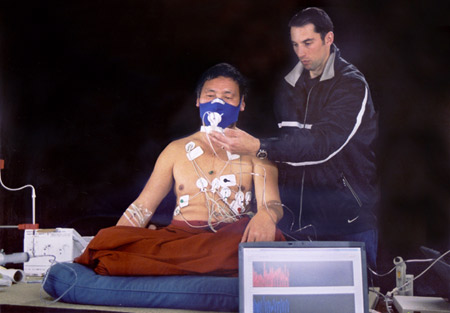
Today I found out that some Tibetan monks can control the temperature of their skin through meditation. Specifically, they have been shown to be able to raise their skin temperature, measured from their toes and fingers, as much as 17 degrees Fahrenheit, while their core temperature stays normal.
 
Scientists from Harvard University, lead by Herbert Benson, were first able to study these monks thanks to the Dalai Lama, who visited Harvard in 1979, and agreed to help them contact and convince the monks to allow them to be studied.
 
What followed was a series of visits to remote monasteries in the Himalayan Mountains throughout the 1980s.
 
Not only did they discover the monks could raise their surface temperature while keeping their core temperature normal, but they also found a group in Sikkim, India that could lower their metabolism by 64 percent. For perspective on how remarkable this is, when you sleep your metabolism drops only 10-15 percent.
 
The scientists also got a chance to document the monks spending a night out on a rocky ledge in the Himalayas. The monks were dressed in their simple wool robes with no extra insulation and slept on the cold rocks separated from one another.
 
The altitude was 15,000 feet and the temperatures reached zero degrees Fahrenheit as they slept, apparently comfortably, through the night. With as little insulation as they were wearing and laying on the cold rock separated from one another, this should have killed the monks. But they were all fine and the cameras didn't even catch them shivering at any point. When they woke, they walked calmly back to their monastery, not seeming to notice the cold at all, unlike the scientists and camera crew who were all bundled up and freezing by morning.
 
It is not yet known how the monks manage to generate the heat, but magnetic resonance imaging scans of the monks brains while they meditate have shown "marked differences in blood flow to the entire brain", Benson explains. "At the same time, certain areas of the brain became more active, specifically those that control attention and autonomic functions like blood pressure and metabolism."
 
The ability to sustain themselves in extreme low temperature and low oxygen environments by raising their skin temperature and lowering their metabolism drastically, would be particularly useful for NASA in missions such as traveling to Mars. If their astronauts could do this, it would drastically decrease the amount of oxygen and energy needed in such a voyage. *queue Space Monks*


Sources: