Wednesday, May 25, 2022

Meteor-hit hinted by the nimitta-s of the Mahābhārata

The most often used term in the Mahābhārata is ‘Nimitta’ which  means ‘omen’. The nimitta can be good or bad and seen on one’s own body or in one’s surroundings. Popular example for nimitta-s experienced on one’s body is that of Sītā who started noticing odd throbs in her body while she was about to end her life. She felt a quiver on her left eye, left shoulder and left thigh which are regarded as auspicious nimitta-s (VR: 5.29.4). Feeling these sensations in her body, she regained her calm that something good was going to happen and no sooner than this, Hanumān appeared before her as a messenger of Rāma.  

In the Mahābhārata too, Arjuna experienced such nimitta-s on his body - as goosebumps, dryness on his face and his skin and a shiver in his hands such that his famous bow kept dropping down. He recognized them as inauspicious nimitta-s (MB: 6.23.29-31) and decided not to fight. These nimitta-s felt by oneself on one’s own body while passing through moments of distress or agony, appear as forewarnings from the Antarātman (the In-Dweller within oneself) about what is going to happen.

When nimitta-s appear in Nature, at the three levels of existence, namely Bhūḥ, Bhuvaḥ and Svaḥ (terrestrial, including the animal and the bird kingdom, atmospheric and celestial), they seem to be the forewarnings given by the Paramātman. The Universe is the body of the Paramātman and in tune with the saying that if something were to happen, the entire universe will conspire to make it happen, the indications are seen at all levels of the visible universe. These include eclipses and the falling objects (meteors) which are observed for their size, colour, rays, brilliancy, shape etc. When seen with odd behavior of animals and birds at the terrestrial level and abnormal features at the atmosphere, they are noted as nimitta-s.

Almost all the so-called ‘astronomy observations’ found in the Mahābhārata are nimitta-s of this nature and mentioned along with terrestrial and atmospheric nimitta-s. For example, an eclipse is a nimitta only if sighted with an inauspicious appearance and also along with adverse indications at terrestrial and atmospheric levels. During the entire period of the Mahābhārata story, many eclipses had occurred but not all of them were mentioned as nimitta-s. Only three eclipses find mention in the text as nimitta-s and are described along with the nimitta-s at the other levels of Nature. In this way,  more than seventy-five nimitta-s were mentioned by Vyāsa, thirty-two by Karṇa and sixteen Drona. They were either mentioned at the moment of appearance or soon after the event of the observation, but invariably linked with a bad effect.

One will be surprised to know that the spiteful talks of Karṇa and Duryodhana when Draupadī was humiliated were brought to an end by Dhṛtarāṣṭra not by any saner counsel, but on hearing the howl of a jackal in the Agnihotra (homa) chamber, followed by the braying of  asses and the cries of birds – something perceived as ‘nimitta.’ (MB: 2.63.22-24). Vidura and Gandhārī who were well versed in the features of this kind of “utpātam ghoram” conveyed this nimitta to Dhṛtarāṣṭra and that made him call for a halt to the harassment to Draupadī and give her boons by which she got the Pāndava-s released from bondage.

Extra-terrestrial impact on the moon and the earth

As we go through all the nimitta-s given in the Mahābhārata, we get amazing hints at the odd events that caused such nimitta-s. The oddest of all is a weird observation pertaining to the moon. Before leaving Hastināpura on his peace mission, Krishna had a personal talk with Karṇa, when Karṇa stated, “somasya lakṣma vyāvṛttaṃ” (MB: 5.141.10). The same verse was repeated by Vyāsa to Dhṛtarāṣṭra before the war began – “vyāvṛttaṃ lakṣma somasya” (MB: 6.2.32). This literally means, “The mark (sign) of the moon became separated or parted with.” This observation looks bizarre but it refers to some abnormality with reference to the features found on the lunar disc.

Waning phase of the moon with the lunar mark shifted (hypothetical)

Scientifically speaking, atmospheric turbulence can make the lunar surface shimmer for naked eye observation, by which the dark marks on the lunar surface appear blinking or shaky. Such appearances are common even today that a regular sky watcher can see the shimmering appearance many times in his life. But here, a single mark is said to have appeared separately which is observable only if it appeared on the featureless part of the moon. Every other nimitta, given by Karṇa and Vyāsa seem to be centred around this odd nimitta pertaining to  the moon.

For instance, Vyāsa, referred to an Amāvāsyā (No-Moon) on the thirteenth tithi, which is impossible to happen in nature (MB: 6.3.28).  A tithi is a lunar day, just 12-degree distance travelled by the moon from the sun in the sky. Counted from the Full Moon Day (Paurṇamī), the 15th part occurs on the No-Moon Day at 168 to 180 degrees. At times Amāvāsyā  had started before 168 degrees but ended up between 168 and 180 degrees (from 14th to 15th phase), but it can never start on the 13th tithi (between 144 and 156 degrees).

The 13th tithi Amāvāsyā can never happen unless the circumference of the moon’s orbit had changed from the original. As per current knowledge, the moon is 252,088 miles away from us at the farthest distance and 225,623 miles when it is at the closest. The average orbital distance is 238,855 miles. At the average distance 30 phases occur that correspond to 30 tithi-s (15 in waxing and 15 in waning phase).

The duration of a phase at average distance = 238,855 / 30 = 7961.8 miles.

Now let us find out the range between the closest and farthest.

252088 - 238855 = 13233 miles.

This divided by 7961.8 = 1.66

This means that between the closest and the farthest orbit of the moon, the phases can vary within 2 phases (1.66) only.

At the farthest it is 15 +1

At the closest it is 15-1 (14th tithi)

That is why never it is stated in any text of astrology that Amāvāsyā (No-Moon) or Paurṇamī (Full-Moon) can happen on the 13th tithi. If the 13th tithi phase occurs, then it means something went amiss with the moon. This drift can happen over millions of years but not in a day or within a phase or two, i.e., within a month.

Oral Legend about the earlier than normal Amāvāsyā

The earlier than normal Amāvāsyā finds mention in an oral legend in the Tamil speaking regions, of Kṛṣṇa choosing to do Pitru Tarpana well before the expected day of Amāvāsyā to deny the advantage of starting the war preparations on Amāvāsyā, by the Kaurava-s. Perplexed by Kṛṣṇa’s action, the sun and the moon approached him saying that the Amāvāsyā had not yet come. Kṛṣṇa pointed out that Amāvāsyā occurred then and there since both the sun and the moon had come together. This story has a flaw. Kṛṣṇa could not have done the Tarpana because his father was alive at that time. He passed away only after Krishna left the world. But the main theme of this story is the arrival of Amāvāsyā well before the normal time which is not possible unless something disturbed the earth-moon system upsetting the regular time-motion speed.

Suppose the fragments of an extra-terrestrial object hit the earth and the moon simultaneously with great speed, the earth-moon system (z-axis) gets disturbed causing both the earth and the moon take up different alignment before they regain their normal. This is not the first time we come across a disturbance to the moon in the Vedic texts. In Raivata manvantara, the fall of Revatī by the kick of the sage Ṛtavāc and the subsequent return to the original path by the moon is suggestive of a simultaneous cosmic hit on the earth-moon in a distant past, by which we come to know that the early society had noticed a change in the path of the moon and a return to the path in course of time (Markandeya Purana: Ch.75).

In the Mahābhārata too, right from the time Kṛṣṇa started his peace mission on Revatī, till his return on the day of Uttara Phalguni in the month of Kārtika, there are frequent references to nimitta-s suggesting meteor-showers and their after-effects. The impact on the first day was terrible that water flowed in opposite direction in seven rivers including the River Sindhu (MB: 5.82.6). While Karṇa referred to Meteors (Ulkā) falling from the sky with loud noise (MB: 5.141.10), Vyāsa was more explicit stating “dhūmaketur mahāghoraḥ puṣyam ākramya tiṣṭhati” (MB: 6.3.12).

The word Dhūmaketu generally refers to a comet and it turns out to be so in this verse too, going by the description of nimitta-s after Bhīṣma was made the chief of the army on that day. The hit is similar to the crash of the comet Shoemaker-Levy on Jupiter, after being caught in the gravitational field of Jupiter in 1994, and breaking into several pieces and falling on Jupiter over a span of seven days with the biggest fragment falling on the 3rd day. 

Scientific evidence for the meteor-hit in the Mahābhārata

Scientifically speaking, simultaneous collision of fragments on the earth and the moon has a probability ratio of 23:1. The impact of a major cosmic hit on the earth is detected as a rapid temperature drop in GISP2 graph. The meteor/fragments entering the Earth atmosphere, at 2000-3000 C, produce different radioactive substances, such as 10-B (radioactive Beryllium) and 14-C and are reflected as several proxies.

Interestingly, four sharp drops are noticed in GISP2 graphs around 5000 years ago with three of them located on the earth with only one not detected historically. That was 3136 BCE – the year of the Mahābhārata war. The description of the nimitta-s months before the war point out to the “Hastināpura event” matching with the rapid temperature fall in  the GISP2 graph.  The four dates and the locations are,

1.         Andaman Sea 3210 BC

2.         Hastināpura 3136 BC

3.         Morasko 3040 BC

4.         Burckle 2920 BC

3136 BCE was the 36th year before Kṛṣṇa left his mortal coils which marked the first year of Kali Yuga – a time scale that we continue to use in our country for all religious purposes. The Kali Year is well marked in numerous inscriptions at 3101 BCE, which was 3179 years before the current Śaka, the third Śaka, namely Śālivāhana Śaka. The year of Mahābhārata war being Pre-Kali 35, the comet hit described by various nimitta-s fit well with the GISP2 graph of a meteor impact in the same year.

Graph courtesy: Joachim Seifert, Climate scientist

A major proxy for a meteor impact is the abundant release of NO2 (nitrogen dioxide) in the atmosphere. It is reddish-brown in colour that it causes red clouds, bloody rains and makes the waters appear blood-red in colour. All these are repeatedly expressed as nimitta-s in the Mahābhārata.

There is a research article by Dr. Dr. Quanzhi Ye and others of a comet breaking up near the orbit of Mercury 5000 years ago, reported in the NASA website on 19th August, 2021. This gives a scenario of broken parts strewn around, some of them racing towards the earth and the moon and hitting them over a period of 13 days, with the bigger fragments falling on the 1st and the 9th day. That comet was seen by the earthlings, claims the article. Vyāsa’s assertion “Dhūmaketur mahāghoraḥ puṣyam ākramya tiṣṭhati” (MB: 6.3.12) goes to prove that the people had seen the Comet and also seen it appear horrible on Puṣya day after which it was no longer visible. That is why he used the term ‘tiṣṭhati’. The visible comet turned invisible by the Puṣya day, though the initial broken pieces started descending on the earth from the day of Revatī.

Evidence of the meteor-hit at Mohenjo-Daro

The most credible evidence of the impact exists in the Sindhu region but is mired with controversies for nearly 100-years. This comes from the strewn skeletons found in the Lower Town in Mohenjo-Daro, presumed to be “massacre victims” of the invading Aryans, by the proponents of the Aryan Invasion theory. However, a study by David Davenport found out radiation in the site, caused by intense heat followed by sudden cooling. Moreover, the strange sight of all the four sites of the so-called ‘massacre’ in a straight  line shows a high probability of a shower of meteors - a strong case of which exists in the Mahābhārata.

Picture courtesy: Hemphill Brian (2020)

The location of the Great Bath so close to this site but not having any sign calamity goes to show that the Lower Town was the oldest and the original township during the Mahābhārata period. The Great Bath coming up in the Mature phase of the Harappan after 2800 BCE, it goes without saying that no calamitous crash had taken place after the Great Bath was built. By the next millennium, the crash site in the Lower Town accumulated debris and the memory of the gory past was completely forgotten. The locally prevalent meaning of this place, Mohenjo-Daro as the “Mound of the Dead”, was perhaps derived from a long-lost memory of the crash during the Mahābhārata time.

The discovery of this site offered fodder to the Aryan debate. With the comet-theory backed the Mahābhārata, it is time a fresh approach is made to examine the date of this site and the dead. This region is more likely to have borne the brunt of the collision mentioned in the Mahābhārata.


***

This article is based on my book “Mahabharata 3136 BCE: Validation of the Traditional Date”.

To get a copy of the book write to jayasreebooks@gmail.com 


Friday, May 6, 2022

Published my book “Rāmānuja Itihāsa: Decoding the identity of Krimikaṇṭha Chola and the Muslim invader at Melukote”


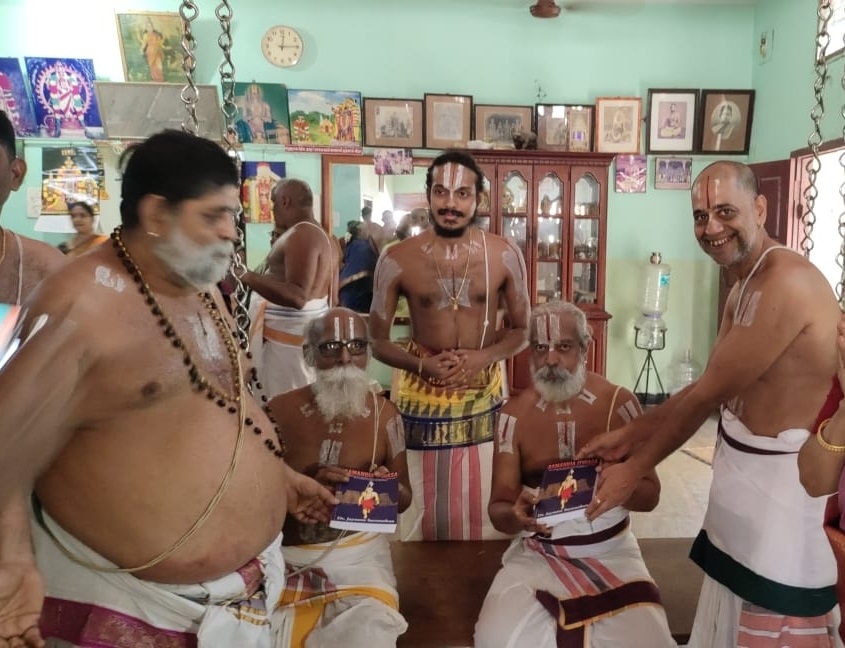
Today, at the conclusion of the Ramanuja Jayanti celebrations at Sriperumbudur, my book ‘Rāmānuja Itihāsa’ was published by our Acharya-s. After seeking the blessings of Srimad Ramanuja, the book was published at Koyil Kandhadai Appan Swamy Thirumaaligai by five Acharyas of Ramanuja Sampradaya.


From left to right: 
Appan Swamy, Doddachar Swamy, Kumara Venkatachar Mudaliyandan Swamy (standing in the middle), Ilayavalli Swamy and Thirumani Swamy

My humble Namaskaram to all the Swamy-s and Acharya Ramanuja. 

About the book

This book is of immense importance for having solved two historical mysteries in Ramanuja’s life that have far reaching implications for our understanding of the history of the medieval Cholas and the unrecorded earliest incursion of Islamic iconoclasts into southern India in the 11th century CE after the death of Mahmud of Ghazni.

In the course of finding out the answers for two questions - on who persecuted him and who looted the deity of Melukote - the book explores Ramanuja's journey from Srirangam to back to Srirangam in the course of which later day history is also revealed - of the destruction spree of Tipu Sultan on the temples and monuments associated with Ramanuja when he came to know that the martyrdom of the Ghazi who looted the deity of Melukote was made wasteful by Ramanuja by having successfully restored the looted property. Ramanuja was perhaps the one and only person in the entire history of struggle against the Muslim invaders in having reclaimed the stolen property without any violence or bloodshed.

The book further brings to the fore the identity of the Chola King who had thrown out the Main Murti of Lord Govindaraja of Chidambaram into the sea. Ramanuja managed to protect the processional murti of Govindaraja by installing the deity at Tirupati.

Supported by multiple evidences and photographs from a field trip on the trail of Ramanuja, this book is an intellectual feast to both history enthusiasts and the disciples of Ramanuja.

Chapter-wise content of the book can be read here: https://jayasreesaranathan.blogspot.com/2022/04/chapter-wise-content-of-my-new-book.html

For print copy of this book, write to jayasreebooks@gmail.com
The eBook is free for Kindle subscribers. The Kindle version is available in the following links.

https://www.amazon.in/dp/B09ZJBYZRB (India)

https://www.amazon.com/dp/B09ZJBYZRB (USA)

https://www.amazon.co.uk/dp/B09ZJBYZRB (UK)

https://www.amazon.com.au/dp/B09ZJBYZRB (Australia)

Saturday, April 30, 2022

Chapter-wise content of my new book "Ramanuja Itihasa: Decoding the identity of Krimikantha Chola and the Muslim invader at Melukote"

The book “Rāmānuja Itihāsa: Decoding the identity of Krimikaṇṭha Chola and the Muslim invader at Melukote” is set on a detective tone to resolve two historical mysteries in Rāmānuja’s life that have far reaching implications for our understanding of the history of the medieval Cholas and the unrecorded earliest incursion of Islamic iconoclasts into southern India in the 11th century CE after the death of Mahmud of Ghazni.

Spread out into 12 chapters, the substance of this book is being presented here chapter-wise. The book was released on Rāmānuja Jayanti, on 6th May, 2022 at Sriperumbudur, the birth place of Rāmānujācārya. The hardcopy of the book can be obtained from me by writing to jayasreebooks@gmail.com

For Ebook links refer here: Jayasree Saranathan: Published my book “Rāmānuja Itihāsa: Decoding the identity of Krimikaṇṭha Chola and the Muslim invader at Melukote” 


Chapter 1: Primary and secondary sources of evidence on Rāmānuja’s history

The chapter begins with a brief comparison of the traditional Indian method with the more recent western method of historical research. The admissibility of the traditional hagiographies as primary or secondary sources of evidence for historical research is established by both the systems, with the Indian system offering greater scope for layers of scrutiny that are found missing in the modern method. Rāmānuja’s history being the basis of this book, four texts written by his contemporaries and two secondary texts are scrutinized for their appropriateness as evidences after resolving the controversies, particularly in the case of one, where opinions differed among Vaiṣṇavite scholars. The chapter also authenticates Rāmānuja’s birth date as CE 1017.


Chapter 2: Persecution of Rāmānuja and others

This chapter is about the circumstances leading to Rāmānuja’s exit from the Chola country. While all the hagiographies of Rāmānuja state that his disciple impersonated him when summoned by the king, to protect Rāmānuja and facilitate his quick exit from the country, no historian is ready accept that Rāmānuja faced any threat, though they have no misgivings in blaming the riots for the death of the king, as a consequence of Rāmānuja’s exit. This chapter uncovers the defects in this version while narrating the sequence of events leading to the persecution of the disciple and the teacher of Rāmānuja who went to meet the king. The eyes of the two were plucked by the king’s order that caused the teacher, aged 105, lose his life. Not aware of these developments Rāmānuja left the country along with his disciples. The year of this event is established as CE 1078.


Chapter 3: From Srirangam to Tonḍanūr

This chapter traces Rāmānuja’s journey from Srirangam to Tonḍanūr (near Mysore) in Karnataka. The first break-through in this research comes from an inscription in a rocky cave called Pāndava Kallu near Nāgamaṅgala, where Rāmānuja meditated for some time. This was supposed to be the place where Pāndava-s stayed during their exile. From there Rāmānuja moved to Śāligrāma and then to Tonḍanūr where he cured the daughter of the King, Viṣṇuvardhana and won the Jains in a debate in the Manḍapa of the Narasimha temple. All the temples were in ruins and without deities when Rāmānuja arrived at Tonḍanūr. The controversies about whether he converted Jain Basadi-s to temples and Jains to Vaiṣṇavism are resolved in this chapter.


Chapter 4: From Tonḍanūr to Melukote

This chapter covers the events at Tonḍanūr, prominent one being the construction of a dam across a narrow gap between two hills to stop mountain currents. It resulted in the formation of a tank, called Toṇṇūr Kere today. Six hundred years later, the bund was destroyed by Tipu Sultan on coming to know that a Ghazi lying in a tomb on the side of the tank was a follower of Mahmud of Ghazni and that his martyrdom was made worthless by Rāmānuja by having successfully got back the looted property (Deities of Melukote). Rāmānuja was perhaps the one and only person in the entire history of struggle against the invader-Muslims to have got back the looted treasure without any bloodshed. Unable to bear that historical feat of that frail old ascetic, Tipu went about destroying all monuments associated with Rāmānuja.  The Toṇṇūr bund was broken causing instant floods that wiped out considerable population of Tonḍanūr. The temple of Yoga Narasimha where Rāmānuja used to spend most of his time was destroyed by Tipu where he installed the tomb of the Ghazi.  The loot at other temples and the complete destruction of the Maṭha of Rāmānuja by Tipu seemed as though Rāmānuja was posthumously persecuted. Getting back to the trail of Rāmānuja, the chapter narrates the entry of Rāmānuja into the nearby hill of Melukote in CE 1099 where he discovered the main mūrti of Tirunārāyaṇa buried near a tank. Epigraphic evidence is produced to show that he brought the priest from Srirangam with the help of Vikramāditya-VI, a friend of Viṣṇuvardhana’s father, to conduct the worship for the deity.


Chapter 5: Muslim invasion at Melukote

The missing deities at Tonḍanūr and Melukote indicating pillage by the raiders, this chapter traces their identity from the evidences gathered around the ‘fanatic follower’ buried at Tonḍanūr. Two of them who entered India along with Syed Salar Masud, the nephew of Mahmud of Ghazni managed to cross Mālwa that had a friendly treaty with Masud, and came along the west coast of Karnataka and Konkan with a small army, plundering the temples on the way. The Persian chronicle giving this information stops at Kannur in Karnataka as the destination of the two and the death of Mir Bakhtiar in a fight with the local army. The tomb of the follower of Mahmud found only at Tonḍanūr, the rest of the story is gathered from the evidences at Tonḍanūr and Melukote. The iconoclasts had turned to Tonḍanūr on their return journey. In the scuffle with the locals, one of them, Mir Bakhtiar was killed. He was buried by his partner, Sulutanu-e-Salateen who decamped with the spoils and reached Delhi. The complete silence of the Hoysala history for 20 years corresponding to this time goes to prove that they were the worst hit by this raid. The attack on Mālwa by the Hoysaḷa-s after this period is understood to be a revenge on the Bhoja-s for letting the ruthless attackers a safe passage. The route taken by the intruders and the Hoysaḷa-s are illustrated to show that they are similar.


Chapter 6: Proof of Delhi visit

This chapter establishes the trip to Delhi by Rāmānuja to recover the looted deity. With the old Hindu saint asking for just one mūrti, stolen by one among them in the past, the custodian of the plundered wealth identified as Dillīṣa of Turkish origin in the hagiographies, didn’t mind allowing him take it back. But this mūrti happened to be the playmate of the daughter of this chief. She followed Rāmānuja to get it back but fell dead after seeing the deity consecrated in the temple. This chapter brings to the fore the numerous evidences from folk songs and literary works on the veracity of this account and the performance of marriage festival between this girl and the deity since Rāmānuja’s time, that left an imprint in the marriage traditions of the nearby villages. The downtrodden people who helped Rāmānuja on his return journey were honored with titles and rights that continue even today, testifying Rāmānuja’s Delhi visit.


Chapter 7: The identity of Krimikaṇṭha Chola

With Rāmānuja continuing his exile in Melukote and the persecutor king still in the Chola throne, this chapter focuses on establishing the identity of this king. It is proved that Kulottuṅga- I was not the persecutor. He had taken in charge of the temple at Srirangam only after Rāmānuja left. Rāmānuja’s name missing from the list of the Srikāryam of the temple produced by historians is shown as counter proof of their claim. The literary evidences on the presence of a king are discussed. That king was Adhirājendra, a direct heir to the throne. The historical blunder of historians in assuming that this king died in CE 1070 that led to the coronation of Kulottuṅga- I (not a direct heir) is disproved by an inscription of Adhirājendra appearing in CE 1071. The elevation of Kulottuṅga- I was in tune with the practice since the days of Rājarāja- I to have a co-ruler. Kulottuṅga was a co-regent with his base at Kānci.


Chapter 8: The myth of the death of Adhirājendra

This chapter focuses on refuting the arguments of historians that Adhirājendra died early and that he was a weak ruler. Inscriptions are listed to prove that Adhirājendra was a powerful warrior who brought victories in Ceylon and Kadāram (modern Kedah). He had his presence in Kālahasti too, that was the epicenter of a feud between Vaiṣṇavas and the followers of Śiva to convert Lord Venkateśwara of Tirupati into Skanda! Rāmānuja successfully thwarted that attempt. Only after this incident, he was persecuted. The chapter continues to present evidences to show that Kulottuṅga ruled from Kānci after the death of a Chola king in a riot. This death is reported by Bilhana in Vikramānkadeva Carita on the life of Vikramāditya-VI, and is given as evidence for the death of Adhirājendra by historians. But this death happening in 1070 is no proof for Adhirājendra’s death but the death of a co-regent, Rājamahendra, the brother of Adhirājendra’s father. The lists of all the kings given in various inscriptions of three kings before Adhirājendra are furnished to prove that Rājamahendra was a co-regent who suddenly disappeared from history. The lists of kings found in the Tamil literary works starting from Kulottuṅga I to three generations after him are also shown to establish that Kulottuṅga I succeeded Rājamahendra as a co-ruler from Kānci throne.


Chapter 9: Kulottuṅga- I succeeded Rājamahendra at Kānci

This chapter discusses the background of the riot at Kānci resulting in the death of Rājamahendra in the riot. By this time (1070) all the heirs to the Chola throne from the family of Rājendra- I were dead in different wars. The world knows only one side of the story of the Chola-s of the 10th and 11th century as successful in territorial expansion and overseas victories. But the price they paid for this was heavy in terms of loss of all eligible heirs in various wars. Only Rājamahendra and Adhirājendra survived, between whom the former was killed in a sectarian riot at Kānci. Rājamahendra’s Vaiṣṇavite leanings led to his death in the brewing clash between two sections identified as ‘right-handed’(Valaṅgai) and ‘left-handed’(Idaṅgai) - where the right-handed were Viṣṇu worshipers and the left-handed were heretics worshiping Śiva in unorthodox ways. With Adhirājendra continuing in the main throne, Kulottuṅga, the son of the daughter of the Chola family was sent as co-regent to Kānci at a very sensitive time in history which mainstream historians failed to sense. 


Chapter 10: Idaṅgai, Kāpālika, Kālāmukha influence on persecution

This chapter outlines the socio-political struggle between the two sects, Valaṅgai and Idaṅgai since the time of Rājarāja- I, with each section trying to influence the king. The origins of the two are traced from multitude of evidences starting from Mahābhārata. Valaṅgai had 18 divisions corresponding to 18 groups of Yādava-s who accompanied Krishna from Mathura to Dwaraka. They migrated to South India at the decline of the Harappan culture around 1500 BCE and expectedly were devotees of Viṣṇu. They formed influential agricultural and warrior class rising up in socio-political hierarchy from the time of Rājarāja- I. The stone workers among them settled down in Kānci. There was a second wave of migration around the beginning of the Common Era when 96 sects of heretics from the Indus region were sent by the Śatakarṇi-s to the Chera land, i.e., Kerala. They grew into 98 sects and spread across many places of Tamilnadu and Karnataka. They were predominantly traders and weavers. A substantial number of them settled down at Kānci. Mutual enmity started growing between them and the Valaṅgai wherever they co-existed. We find disparaging references to Idaṅgai sects in the commentaries of Ādi Śankara and Rāmānuja to Brahma Sutras. Rāmānuja naturalized them into the main stream by making them shed unorthodox ways and follow Vaiṣṇavism. This invited the ire of certain Idaṅgai sects who were influential with Adhirājendra. Adhirājendra was initially neutral but perhaps on seeing the murder of his uncle Rājamahendra, started siding with the Idaṅgai. In contrast, Kulottunga who basically had Idaṅgai origins was neutral to both. Choice of Kānci as his base was perhaps aimed at appeasing the Idaṅgai who had dominant presence there. These intricacies are discussed in this chapter to bring forth the background causes for persecution. The sectarian feud had continued in the British period and exists in pockets even today though the origins are forgotten.   


Chapter 11: Date of return of Rāmānuja

The chapter establishes the date of return of Rāmānuja to Srirangam in the year CE 1111. Since all the hagiographies state that Rāmānuja returned only after the death of the persecutor king, it is understood that Adhirājendra died in this year. The unique name, Krimikaṇṭha that he came to acquire is a reference to the disease he suffered, i.e., throat cancer. The first inscription of Kulottuṅga I from Gangaikonda Cholapuram appears only in this year which happened to be his 41st regnal year. Viṣṇuvardhana’s lone inscription appears at Srirangam only in this year indicating that his men had escorted Rāmānuja back to Srirangam. This is a rare inscription giving his regnal year (15th) by which we are able to construct his regency. Vikrama, the son of Kulottuṅga- I was recalled to Gangaikonda Cholapuram in the same year to take up co-regency. In the same year the king of Kannauj, a friend of Kulottuṅga- I visited Gangaikonda Cholapuram, presumably to grace the occasion of the crowning of Kulottuṅga- I.

Chapter 12: Removal of Lord Govindarāja at Chidambaram

Back to Srirangam Ramanuja went about introducing norms of temple worship in all the Viṣṇu temples. When he was in Tirupati, Vikrama’s son Kulottuṅga- II who was ruling from the Chola throne destroyed the shrine of Viṣṇu in the temple of Natarāja at Chidambaram. Contemporary panegyrics are cited to prove that the Mūlavar Mūrti of Viṣṇu was thrown into the sea by the king. The Idaṅgai roots of the author of these eulogies authenticate the rise of Idaṅgai influence on Kulottuṅga- II at that time. The chapter gives the background details of all these and also the consecration of the processional Mūrti in Tirupati.


Epilogue: Curious Continuities from Mahābhārata

Rāmānuja’s entire life was a series of struggles against heretics and the two powerful Chola kings, Adhirājendra and Kulottuṅga- II. History of the period between these two kings can be re-constructed ONLY from the traditional hagiographies of Rāmānuja using multiple cross references. This book exactly does that besides hinting at numerous connections between north and south India, unrecognized so far. The impressions gained from a field trip by the author to the places associated with Rāmānuja is compiled in this section to show the similarities in iconography and hydrological features between the Harappan regions including Dwārakā and Tonḍanūr, originally known as Yādavapura, the city of Yādava-s in Karnataka. This section is a starting point for further research in corroborating Pāndava connection to South India during their exile and the migration of the Yādava clan since then, that seemed to have accelerated at the decline of the Harappan regions 3500 years ago.  

Appendix: Idaṅgai – Valaṅgai

A brief note on the two sects is given. The clashes continue even today between individual castes though the origins of this conflicting mentality traced to Idaṅgai – Valaṅgai distinction is now forgotten. Unfortunately, it is re-phrased as clashes between Caste Hindus and Dalits. A genuine and impartial research into Idaṅgai – Valaṅgai enmity is needed to bring out all the details.

****

The Mausoleum built by Tipu Sultan on the temple of Yoga Narasimha Swamy at Tonḍanūr, after destroying it 


Sunday, April 10, 2022

Early Tamils traced their ancestry to Rama (My article in Organiser Magazine)


Not many have known about the wealth of information available in Tamil sources – both literary and epigraphic – giving valuable inputs related to Rama. Foremost among them is the claim by the Cholas that Rama was their ancestor! The second-most important information pertains to the time period of Ramayana. The third set of inputs establishes beyond doubt the location of Lanka of Ravana in present-day Sri Lanka.

Rama, the ancestor of Cholas

Chera, Chola and Pandya are the three ancient Tamil dynasties of which the Cholas belonged to the solar dynasty starting from Surya, Manu and Ikshvaku. One often comes across the reference to ‘Manu-Neeti’ as the hallmark of the Chola kings in their inscriptions. A Chola king is remembered as ‘Manu Neeti Chola’ for having given the highest punishment to his son, the crown prince, for having killed a calf under his chariot. Though it was done unknowingly, the Chola king did not hesitate to punish his son by getting a chariot run over him and kill him. None knows the name of this king as anything other than ‘Manu Neeti Chola’, for being a just ruler. Only the Buddhist chronicle Mahavamsha gives his name and describes his sense of justice in the context of the death of this king in a war in Anuradhapura in Sri Lanka. Though an invader to their domain, in recognition of his unparalleled sense of justice, his mortal remains were cremated with honours and a monument raised, which was worshiped by the kings of that country, reports Mahavamsha in the 25th chapter. 

The sense of righteousness running in the lineage of Manu, it is no wonder that Rama became an epitome of Dharma, to be emulated by any king wishing to follow the right path. If any  king is related to Rama in the remote past, would he lose any opportunity to boast off his filial connection with Rama? We do find evidence for such claim by the Chola king Veera Rajendra, the grandson of Rajaraja Chola -I, engraved in the Pillars of  Bhagavati Amman temple at Kanyakumari. While giving the detailed list of his forefathers starting from Brahma and then Manu, the king has written that in the family of Rama was born a king named Chola who ventured southward and founded the Chola dynasty in Poompuhar – the place deduced from the description.

Verse 26 of the poetically written inscription in Sanskrit, stands out among every other description about Rama, by having addressed the tough events in Rama’s life and how he stood beyond personal considerations. For the curious reader, here is the verse as reported in Travancore Archaeological Series (1921):

Continue to read here:  Early Tamils traced their ancestry to Rama

Tuesday, March 22, 2022

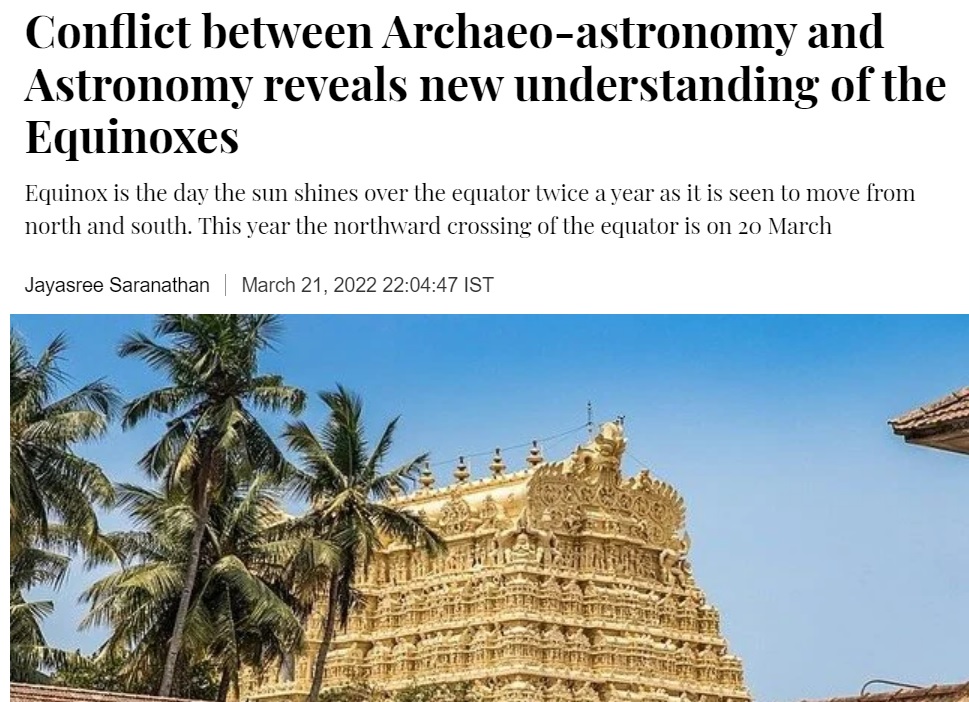
Conflict between Archaeo-astronomy and Astronomy reveals new understanding of the Equinoxes (My article in Firstpost)

This article published in a leading web magazine, Firstpost, establishes by means of Archaeo-astronomy of ancient monuments that there is no change in the alignment between the earth and the sun, thereby indicating that the earth's axis doesn't precess. The precession theory of astronomy shows that there is a continuous change in the alignment between the earth and the frame of reference lying outside the solar system. In the absence of axial precession of the earth shown by archeoastronomy, this could only mean that the entire solar system is precessing with the inmates (at least the earth) retaining a constant configuration with the sun. 

This revelation from archeoastronomy is a game-changing concept that is going to be the basis for future Nobel winning research on the Theory of Precession of the equinoxes. 

Conflict between Archaeo-astronomy and Astronomy reveals new understanding of the Equinoxes-World News , Firstpost


Come 21 March and people are seen thronging certain places of the world — one among them being the temple of Lord Padmanabha Swamy at Trivandrum! The purpose is to see the spectacle of the equinoctial sun passing through the mid-point of the tower, known as Gopura.

Every year the equinoctial days — in March and September — attract many pilgrims and tourists alike wanting to catch a glimpse of the direct solar-rays splash through the openings located one below the other at the middle of the Gopura of the temple.

Equinox is the day the sun shines over the equator twice a year as it is seen to move from north and south. This year the northward crossing of the equator, popularly known as Spring Equinox starts at 15:33 hours, Universal Time (UT) on 20 March. The date of Spring equinox oscillates between 20 and 21 March depending on the leap year adjustment. The unique sighting of the equinoctial sun at the middle of the Gopura is hailed as an archaeological wonder of the ancient builders, though not very ancient because this Gopura was built 400 years ago.

Not so recent is the temple of Angkor Wat in Cambodia built in the 12th century whose central tower offers the fantastic sight of the sun touching its summit only on the days of the equinox. Back in time, four centuries before Angkor Wat was built, the Maya people had made the Temple of Kukulkan in the city of Chichen Itza that is also found to be aligned to the equinoctial sun. On both the equinoctial days, the shadow of the sun makes snake-like body from the head of the serpent carved at the bottom of the structure.

Another structure, the Stonehenge circle in Southern England, built farther back in time in stages between 3100 BCE and 1600 BCE was found aligned to the equinoxes when it was first reported by William Stukeley in his 1740 publication. The alignment continues to be seen even today, attracting a considerable crowd and a new evolving order of pagan worship.

Competing with the antiquity of the Stonehenge is the megalithic structure found on the island of Malta in the Mediterranean Sea — the Mnajdra temple complex. One of its structures has a central passage exactly on the way of the equinoctial sunlight and the two edges of the passage align with the two solstices. This structure is perhaps the most researched but has also left researchers most bewildered. Graham Hancock is of the opinion that it could have been built 12,000 years ago, in the earlier precession cycle, but the archaeological evidence do not place it beyond 5,000 years ago.

A number of other structures of lost civilisations are found to be exactly oriented to the equinoctial sun. Some of them have been documented by the NASA website, while many others are being unearthed by archaeo-astronomers. To mention some of them, the giant rock on top of a mountain in Machu Picchu of the Incas in Peru built in the 15th century, the Grianan of Aileach of Ireland built around the 6th-7th century and the Ahu Akivi statues of the Easter Island built in the 15th century are found positioned in such a way that they face the equinoctial sun.

Many churches in Europe, built centuries ago, are also seen to have openings in strategic places on the wall to allow the sun’s rays to fall on the altar exactly on the equinox days.

Such perfect alignment of these structures with the equinox of today is astounding and unbelievable as per current scientific understanding of a phenomenon called ‘precession of the equinoxes” that is attributed to the precession of the earth’s axis.

Current science on precession of the equinoxes

It is true that the sun’s position in the backdrop of the star-studded sky does not come back to the same position at the time of equinox (sun shining on the earth’s equator). The equinox of every succeeding year falls 20 minutes short of the previous year thereby causing a shortfall of one day every 72 years. By this time, the sun moves one degree in the sky. This backward movement of the equinoctial point is known as the precession of the equinox.

Continue to read HERE


Sunday, March 13, 2022

Shubhakrit New Year Book-sales offer

In tune with my insistence on following our Vedic Time scale, I welcome Shubhakrit New Year starting from Mesha Saṅkramaṇa with gift of my book to those who purchase any of my books. This offer spans from Meena maasa to Mesha Maasa and starts from tomorrow. All the dispatches of books from tomorrow will be carry one of the books of the reader's choice, either "ஆண்டாள் தமிழும் அறியாத வைரமுத்துவும்" or "When was the First Vedic Homa done?"

Details about the three books can be read in the links provided. 

1. Mahabharata 3136 BCE: Validation of the Traditional Date  (Rs. 475)

2. Myth of The Epoch of Arundhati of Nilesh Nilkanth Oak"  (Rs. 230)

3. Oral Cancer: Astrological prediction and remedies" (Rs.250)

The complimentary book can be chosen from any one of these:

1. ஆண்டாள் தமிழும் அறியாத வைரமுத்துவும்" 

2. When was the First Vedic Homa done? 

There is going to be another major publication before the start of Shubhakrit New Year about which the details will be given soon.

Write to jayasreebooks@gmail.com to get your copy.


Wednesday, March 9, 2022

"Janamejaya inscription: Mahabharata's veracity proved" - My article in 'Organiser'

I am glad to share the link to my article on Janamejaya inscription found in the custody of Bhimanakatte Matha offering solid proof for the year of the Mahabharata war on 3136 BCE (Pre-Kali 35 years). I have spelt out the objections to this grant and offered my counters to them. I am thankful to the Editorial Team of Organiser, the esteemed magazine of the RSS for publishing the crucial piece of evidence for the year of the Mahabharata war at 3136 BCE and for the beginning of Kali Yuga on 3101BCE. 

From 

Janamejaya Inscription: Mahabharata’s Veracity Proved (organiser.org)

Janamejaya Inscription: Mahabharata’s Veracity Proved

Dr Jayasree Saranathan

DR JAYASREE SARANATHANMar 08, 2022, 12:19 PM IST                                           


The Janamejaya inscription, demonstrating the authenticity of the Mahabharata, was found to have been made 5,000 years ago. However, British historians were reluctant to accept that Bharat had such a thriving civilisation

Inscriptions are accepted as foremost primary evidence in historical studies. They belong to the genre of written documents or Lekhya Pramana approved by Shastras, according to the late Dr Nagaswamy, historian and preeminent epigraphist. 

The date of the inscription mentioned in Jyothisha units of time such astithi, star and week-day are therefore reliable. The dates of many kings and dynasties have been deciphered from the year of the Shaka or Kali Yuga found in the inscriptions.

Historicity of Mahabharata

In the same way, the year of the Mahabharata war can be derived using the well attested evidence of a 35-year gap between the war and Krishna’s exit given in four verses in the Mahabharatatext (MB: 11.25.4; 16.1.1; 16.2.2; 16.3.18,19). This makes locating the year of the war easy: it was pre-Kali 35 years. Counted from the completed Kali years as of today (that we continue to use for all religious purposes) 3136 BCE was the year of the Mahabharata war. Though there is no direct epigraphic evidence for this date, five inscriptions have been located so far, bearing the name of King Janamejaya, the great-grandson of Arjuna, as donor. This article highlights one that bears strong evidence for the year of the war and the historicity of the Mahabharata.

For people, who believed that the earth was created only 5,000 years ago, it could have been a rude shock that India had a thriving civilisation 5,000 years ago. Secondly, that was the time that the Aryan Invasion Theory was gaining momentum, which denied the indigenous origin of the Vedic culture and proposed that ‘Aryans’ from Europe brought the Vedic culture to India 3,500 years ago 

Janamejaya Inscription Down South 


Read the rest of the article here: Janamejaya Inscription: Mahabharata’s Veracity Proved (organiser.org) 


Friday, February 11, 2022

My talk on the authenticity of the Janamejaya Grant

On the day of Pushya Amavasya on 1st February, an event called "Nava Darushana" was organized by the Sri. Bhimakatte Mutt in which I was given the opportunity to talk about the authenticity of the grant by the King Janamejaya given to the sages in the same location 5034 years ago. The video of the event can be watched here. My talk starts from 49th minute onwards. I have spoken about the objections to the grant and given my counters to those objections. 


Sunday, February 6, 2022

Received wishes from Sri. Dharmendra Pradhan, Union Minister of Education, for my book "Mahabharata 3136 BCE"

My sincere thanks to Sri. Dharmendra Pradhan, the Union Minister of Education, for taking time to go through my letter and my book "Mahabharata 3136 BCE" and sending his good wishes.