Saturday, January 29, 2022

Review of my book, “Mahabharata 3136 BCE” by Mr. Come Carpentier de Gourdon

 The review of my book “Mahabharata 3136 BCE: Validation of the Traditional Date” by Mr. Come Carpentier de Gourdon, published in India Foundation Chintan Blog can be read here:

https://chintan.indiafoundation.in/articles/mahabharata-3136-bce-validation-of-the-traditional-date/
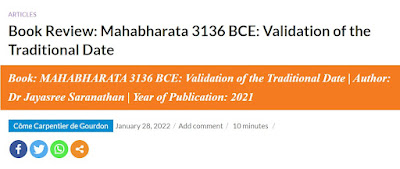

Mr. Come’s subject knowledge in astronomy, cosmology and Hindu texts was palpable at every line of his review. I was simply elated reading his views on the three issues that are central to my book both for dumping the other works that have used astronomy simulator and for the right grasp of the not-so-hidden evidence of the meteor hit and the location of Krishna's Dwaraka.

Those three issues of critical importance articulated by him are listed below along with the chapter numbers:

1. The non-feasibility of the use of astronomy simulators for dating (Ch 1 and 2)

2. The meteor-hit (Ch 10 and 11)

3. Location of Krishna's Dwaraka and causes for its submergence (Ch. 18)

(For easy navigation of my book, I would suggest the readers  to read the 3rdchapter to know about Yuga-s and the 4th chapter, about epigraphic evidence. Introduction and Epilogue are must-reads. The rest are little technical)

However, I have a different pick on two points he raised in the last paragraph which I shared with him through email. They are about the Puranic list of kings and the drying up of the river Saraswati.

First, the Puranas are not treated on par with the Itihasa-s, for, the latter are exact accounts (“it happened thus”) while the Purana-s are NOT taken at face value completely, particularly for historical purposes. The Puranic list of kings is not primary evidence but  must be supported by other evidences such as epigraphy. With no clarity about methodology of dating, many Indic scholars have causally attempted to fit in Puranic list with the Mahabharata date. 

Second, none who have worked on the hydrology of Sarasvati thought about the etymological idea conveyed that the river had sprung from a 'saras' - a pond or a tank and not in the glacier of the Himalayas. The river had shifted its source three times which can be detected from the texts - a saras, near Kuruskshetra and far away beyond Prayagraj (Triveni Sangama). In my opinion, the origin at saras was already lost during the Mahabharata period. Perhaps that made Balarama curious to know from where else the river emerged. The annual return of Sibrian cranes at Shashayana in the Mahabharata - perhaps the former location of Bharatpur Sanctuary must have had a branch of Saraswati running over there and joining Yamuna whose path can be located at Prayagraj. Bharatpur is also an un-checked location. Like this many might have been there. But to use it for dating a specific historical year of the war cannot be primary evidence which I have explained under the caption "Other Evidences" in the 2nd  chapter of the book.

For further  reference: The location of Shashayana on the river Saraswati where cranes annually returned even during the Mahabharata period: (DOC) Annual migration of Siberian cranes to River Sarasvatī | Dr. Jayasree Saranathan - Academia.edu

On the probable location of the Saras from which the river Saraswati descended: (DOC) Harappan was Vedic but Tamil was not Dravidian: A critical evaluation of Iravatham Mahadevan's works. | Dr. Jayasree Saranathan - Academia.edu (from p.27 to 30) 


Friday, January 21, 2022

My article about my book, "Mahabharata 3136 BCE" published in firstpost.com

 Deciphering the year of Mahabharata war and how it holds key to Harappan culture

by 

Jayasree Saranathan 

January 16, 2022 15:56:39 IST

The scientific evidence about a cosmic impact in 3136 BCE is supported by the historical evidence provided by the Mahabharata, making the text a true historical document. The Mahabharata can no longer be called a myth

The need to conclusively establish the year of the Mahabharata war is felt all the more today for two reasons: One, the archaeological findings of the Harappan culture are spread within the geographic extent of the Mahabharata events; and two, the date of the Mahabharata war falls at the beginning of the early Harappan, coinciding with the spread of population.

The chronology of the Harappan/Indus culture given in Harappa.com shows Early Phase/Ravi Phase between 3300 BCE and 2800 BCE. In this period, the Mahabharata war had taken place in 3136 BCE — the year derived from the Kali Yuga computation — a time scale that is followed uninterruptedly till date in India. The inter-connectivity between these two — the Mahabharata and the Harappan findings — needs to be understood to begin with.

 Link between Mahabharata and Harappa

The advanced city planning and material culture detected in Harappa could not have been sudden but a continuation of a pre-existing civilisation. The Mahabharata offers a link to that pre-history. For example, all the top three animal signs found in the “Harappan art” were the same as those owned as totems by the defeated Mahabharata characters — the unicorn by Jayadratha, the son-in-law of Dhritarashtra; the bull image by Kripa, the brother-in-law of Drona; and the elephant by Duryodhana and Shalva.

This raises a curious question of whether the losers had given up fighting and started engaging in Vaishya-hood as ordained by the Smriti texts. The transition in the successive phases of Harappa, showing rise in manufacturing and trade activities doesn’t seem to have a better explanation than this.

Interestingly enough, the absence of ‘horse’ in the Harappan seals is justifiable with the Mahabharata characters in the Harappan region. For, none in the Mahabharata and nobody anywhere in India sported horse as their emblem. Horses appeared in the coinage of the Indian rulers only in the 1st millennium of the Common Era, inspired by the European model of coins inscribed with horses.

The expansion of population in the early Harappan phase matches with fresh settlement of the displaced people of Dwaraka by Arjuna after the loss of Krishna’s Dwaraka into the sea, with the Satyaki clan settling down all along the banks of the river Saraswati, the Kritavarma clan sent to Matrikavata — probably referring to Mehrgarh (Maa-ghar or mother’s house) — and the continuity of the Saindhavas (Jayadratha clan) in the Sindhu (Indus) region.

The early Harappan Indus region shows sparse growth of settlements, indicating lack of migration from mainland regions of the Mahabharata events. In fact, not many preferred to move to those regions even during the Mahabharata time, as known from Karna’s version that the people of that region lost the wisdom of the Vedas by having lived....Continue to read here


Tuesday, January 4, 2022

Review of my book, "Mahabharata 3136 BCE" by Dr. Narayanan Bhattathiri

Yaskacharya, while explaining the Nirukta (Etymology/Semantic etymology) of VRtra and Indra (using the story where in VRtra is killed by Indra), identifies two groups of students in this regard: Historians (Aitihaasikom: i.e. those who believe that VRtra is an actually the son of Asura Tvashtra (i.e they consider the Itihasas (Epics) as history)) and Nairuktas (those who don’t harbor the above belief but rather consider the Epics as allegories and try to derive what they actually represent and the associated meanings.

Dr. Jayasree Saranathan is a staunch Historian in the above sense; and her monumental work, Mahabharata 3136 BCE is the culmination of years of effort to identify when the actual War took place. Of course, it is easy to establish 3136 BCE as the date of the war considering the temporal relation between it and beginning of Kaliyuga at the time of death of Sri Krishna. But this will remain a legend unless and until a connection can be made between some internal event in Mahabharata with a well proven external event. Meticulous research by Dr. Jayasree reveals that certain unnatural events (which can be caused by a comet striking the earth) noticed just before the war finds a parallel with well recognized temperature drop (which can be due to a comet strike)in the Holocene Period, occurring in 3136 BCE. This is an evidential connection not easy to refute. Of course she has suggested further radio dating studies which I am sure will support her contentions.

The work by Dr. Jayasree is a treatise too covering various aspects of Astronomy as well as Jyothisha; one can learn a lot about these subjects by studying this easy to understand book. It will be an asset to any library and deserves translation to all other Indian languages.


Dr. Narayanan Bhattathiri, MBBS DMRT MD PhD

Former Senior Research Fellow, International School of Dravidian Linguistics,

Former Professor of Radiotherapy, Pariyaram Medical College, Kannur Kerala,

Former Assoc. Prof., Regional Cancer Center, Trivandrum, Kerala


Review of my book, "Mahabharata 3136 BCE" by Mr. Chittarvu Sasun

The book Mahabharata 3136 BCE is truly a masterpiece and a delight to all those who are with history-astrology-logic-scientific bent of mind and interest!

There were so many concepts and information provided in this book is alien to me! Some tiny part of logical deductions, I thought is known to me. But this book showed me how much hollow it is and helped me build a completely new insight about:

A) Time concepts and relevance to current day calendars

B) Astrological thinking and interpretation of Mahabharata texts.

C) Scientific evidences in support of the interpretations made like comets, eclipses.

D) Archaeological observations in different parts of the nation and ages are stitched to build a convincing logic.

E) Software for astrology - JHora: I am convinced to bury all my thoughts to own a software like Parashara lite or SriJyothi Star! Incidentally, the creator PVR was my school days buddy! I, like many of my friends, used to amaze at this prodigy!

And many more salient features and unique approach marks the hallmark of this masterpiece! I feel lucky to own this book! With warm regards and many congratulations.


Chittarvu Sasun, M.Tech (IIT, Chennai)

General Manager & Associate Operating Head,

Honda R&D (India) Pvt. Ltd, Gurgaon.


Thursday, December 30, 2021

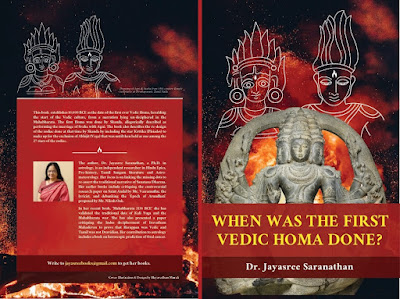
My book "When was the First Vedic Homa Done?"

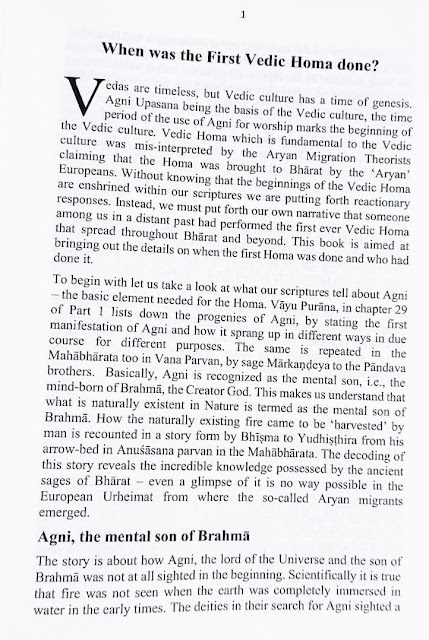
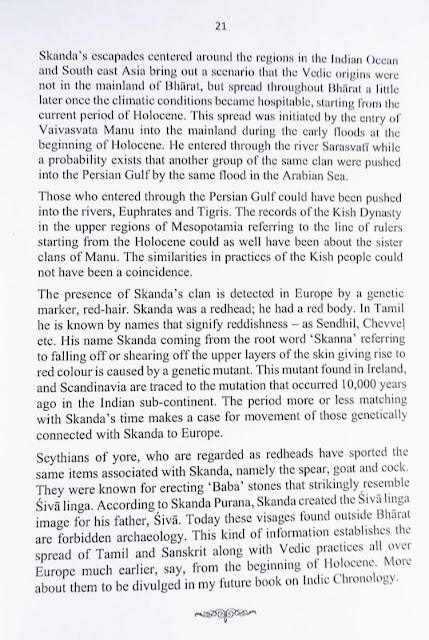
Released a booklet tilted "When was the First Vedic Homa Done?" on 27th December 2021. It traces the story of Agni as given in scriptures and and how and when the first Homa was done. From the narration of sage Markandeya found in the Mahabharata it is known that Skanda conducted the 'marriage' of Svāhā with Agni - symbolic of the beginning of the Vedic Homa. 

The first copy of this book was presented to the Honorable Vice President of India, Sri. Venkaiah Naidu on 27th December 2021. I wish this copy reaches as many people as possible to spread the information about the beginnings of Vedic Homa. 

Click the image to enlarge
The narration is in story form and brings out parallels from Tamil literature on Skanda's role in starting the first Homa. The location of the first Homa and the feasibility factors for the performance of the Homa are discussed. Sample pages are shown below. 


This booklet is of 22 pages and priced at Rs.50. Can be purchased by writing to jayasreebooks@gmail.com 

Can be bought along with other books to save on the postage.
My other books are
"Mahabharata 3136 BCE" (Rs. 475)
"Myth of The Epoch of Arundhati of Nilesh Nilkanth Oak"  (Rs. 230)
"Oral Cancer: Astrological prediction and remedies" (Rs.250)
"ஆண்டாள் தமிழும் அறியாத வைரமுத்துவும்" (Rs. 50)

Wednesday, December 29, 2021

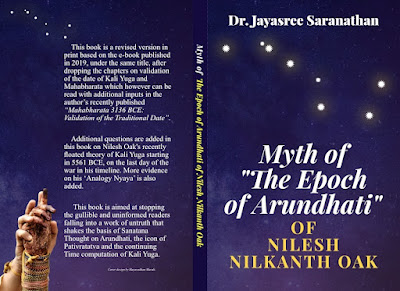
'Myth of “The Epoch of Arundhati” of Nilesh Nilkanth Oak' is brought out in print

 My book ‘Myth of The Epoch of Arundhati of Nilesh Nilkanth Oak’ critiquing Nilesh Oak’s book on the date of the Mahābhārata was originally published as an e-book in 2019. Upon request for print version, I am now bringing out a revised version of the e-book after dropping the chapters on validation of the date of Kali Yuga and Mahābhārata which however can be read with additional inputs in my recently published “Mahabharata 3136 BCE: Validation of the Traditional Date”. 

With no counters coming from Nilesh Oak to my critique till this date, I am adding additional questions in this book on his recently floated theory of Kali Yuga starting in 5561 BCE, from the last day of the war in his timeline. I have added more evidence on his ‘Analogy Nyāya’ too. I don’t expect him to refute my critique for, he never can, but this book is meant for the common man to not fall a prey to a work of untruth.

In an atmosphere of absence of knowledge of even the basic features of our culture, I find the youth of today getting excited over the thought of long past for Vedic India and modern software being put into use to establish the past. But they should not be fed with faulty understanding of texts and concepts and mindless use of simulation for establishing the meaning of even scriptural concepts as Nilesh Oak has done. My book aims to spread awareness about the mediocre nature of the Mahābhārata research of Nilesh Oak.

The first copy of this book was presented to the Honorable Vice President of India, Sri. Venkaiah Naidu when I met him at the Raj Bhavan at Chennai to give my books on 27th December 2021. While briefing him the circumstances that led me to do the research on validating the Traditional date of the Mahabharata war and Kali Yuga, I spoke about my Dharmic Anger against maligning the status of Arundhati and the mis-interpretation of the verses of the Mahābhārata and the date of Kali Yuga. The second copy was given to the Honorable Governor of Tamil Nadu.

This book of 12 chapters in 202 pages is available for Rs. 230. Postal cost of Rs. 36 for anywhere in India is additional. Interested readers may write to jayasreebooks@gmail.com to get the book.


Monday, December 27, 2021

Presented my book “Mahabharata 3136 BCE” to the Vice President of India

 Following the release of my book “Mahabharata 3136 BCE: Validation of the Traditional Date” on 14th November by my family Guru-s at Kanchipuram, I sent my book to the Vice President of India, Sri Venkaiah Naidu for his reading with a covering letter explaining why my book should be read. I requested time to meet him in person to present the book and explain the salient features in person. The Vice president kindly consented to my request and granted me time to meet him at the Chennai Raj Bhavan today during his Chennai visit.

His simplicity and making himself accessible to a common man like me was uppermost in my mind when I met him that I quoted the Tirukkural verse (Kaatchikku eLiyan) on how a ruler who is simple and makes himself available to the people is praised by the world. I also told him that I didn’t bring any bouquets or shawls or costly items, but only a book that is a befitting a scholar like him. Disapproving the bouquets and such other stuff, the Vice president said he was pleased to receive the book than anything else. 


Click the picture to enlarge

I explained him how I have authenticated the Janamejaya grant in possession of the Bhimanakatte Matha (pages 148 to 158 in my book) and presented him the mail of appreciation sent to me by the Swami-ji of the Matha. The grant offers clinching evidence to the year of the beginning of Kali Yuga when Parīkshit ascended the throne following the departure of Kṛṣṇa and the Pāndava-s. Thirty-five years before that, the war had taken place. 


I conveyed the desire of the Swami-ji to commemorate the day of the grant (Pushya Amavasya) from next year onwards and the need to declare the authenticity of the grant.

This was the foremost request in my Letter of Request presented to the Vice President.

Other points of request are as follows:

Ø  Similar grant issued by King Janamejaya on the same date to Uṣā Maṭha in Kedārnāth to be retrieved (p.158 in my book).

Ø  Kali Yuga date to be corrected to 3101 BCE in the Gregorian calendar-reckoning (p.115).  

Ø  Kali Yuga date to be inserted in the Astronomical Almanac (p.114).

Ø  Probe to be undertaken to carbon-date the so-called ‘massacre-victims’ of the Lower Town of Mohenjo-Daro (p.278-281).

Ø  Probe to be undertaken to test the radiation levels at the Lower Town, as reported by David Davenport, to check meteor impact (p. 279).

Ø  Probe to be undertaken to determine the date of the impact at Langtang landslide location (p.284-285).

Ø  Marine excavation to be undertaken to the west of Prabhāsa to determine the location of Kṛṣṇa’s Dwārakā (Chapter 18).

The Vice President promised to forward the Request Letter to the concerned people.

Then I got my book autographed by him for my possession.

Then I presented two other books, the abridged print version of my e-book “Myth of The Epoch of Arundhati of Nilesh Nilkanth Oak” and a booklet titled, “When was the First Vedic Homa done?” I told him how my Dharmic Anger against the so-called Epoch of Arundhati led me to validate the Traditional Date of Kali Yuga and the Mahābhārata war.


It was a satisfying visit and I thank the Vice President for making it memorable.

I am thankful to the staff of Raj Bhavan for delivering my three books (Mahabharata, Myth and Vedic Homa) to the Governor’s Desk since I didn’t get prior appointment to meet him personally to hand over the books, particularly “Mahabharata 3136 BCE”.  

With the blessings of my Acarya-s and the Swami-ji of Bhimanakatte Matha my task continues to stop the distortion of Vyāsa Mahābhārata and Kali Yuga Time scale.


The books can be obtained by writing to jayasreebooks@gmail.com.

 Update:

My meeting with the VPI to present my Mahabharata book was reported as box- news in Eenaadu, the popular Telugu Daily the next day (28th Dec, 2021).  It was earlier reported in 'News Today' published from Vadapalani.


It reads as
"Here is the picture of Dr. Jayasree Saranathan, Writer & P.hD holder in Astrology, accompanied by her husband, handing over the book 'Mahabharata 3136 BCE' authored by her to Vice President Sri. Venkayya Naidu at Raj Bhavan on Monday."

Monday, December 13, 2021

Tamil New Year controversy -Part 3 (On Tiruvalluvar's birthday and Thiruvalluvar Year)

Part 1 - Arguments against New Year in Thai

Part 2 - Arguments in support of New Year in Chitthirai

In the 3rd and the final part of my interview at Desiya Siragugal channel, I am explaining the historical background of the Thiruvalluvar Year and the bungling up of the birth date of Thiruvalluvar by Mr. Karunanidhi. Further on, I am establishing the date of Thiruvalluvar around 7000 years ago - at the end of first Tamil Sangam, on the basis of Sangam poetry evidences. 


Sunday, December 12, 2021

Tamil New Year controversy - Part 2 (My arguments in support of New Year in Chitthirai)

 In continuation of 1st Part posted yesterday on arguments challenging the 'evidences' presented by the supporters of New Year in Thai, the 2nd part is posted today. In this part, I focus on the evidences in support of Tamil New Year starting in the month of Chithirai. I am quoting the records of the colonial period on how 'Tamil Varusha Pirappu' was observed in Chithirai in Madras Presidency. I continue the arguments by quoting the verses attributed to sage Agastya and Sangam age poems. Finally I am giving epigraphic evidence for the start of the year in Mesha. The talk continues tomorrow also and the topic is Thiruvalluvar Andu.


Saturday, December 11, 2021

Tamil New Year controversy - Part 1 (My arguments against New Year in Thai)

Regular and long time readers would have known that I have been consistently questioning the attempts by the DMK governments in the past to change Tamil New Year from Chitthirai to the month of Thai. One can see my talks and articles questioning the change of the New Year, in 2012 archives. Now with the installation of the DMK government in the State, the New Year controversy has come up after the Govt printed New Year wishes on the Ration products distributed for Thai Pongal. In this backdrop, my interview to the You Tube Channel Desiya Siragugal is telecast in three parts starting from today. 

In the 1st part, I am examining the evidences presented by Mr. Karunanidhi and Tamil scholars in support of Thai as the New Year and prove them to be wrong. I am also bringing out the true relevance of  "Pongal" and the genesis of  the three festivals - Bhogi, Pongal and Maattu Pongal - which were basically related to the cattle-breeding Yadava people having allegiance to Krishna. 


Wednesday, December 8, 2021

Mr. Joachim Seifert's view about my book "Mahabharata 3136 BCE"

Mr. Seifert is a familiar name for those who have read my book "Mahabharata 3136 BCE". He works on the climate models of the Holocene, researching on meteor-hits that have caused dip in temperature recorded in GISP2 graphs. Our researches in respective fields matched remarkably that while I pointed out the references to a series of meteor-hits caused by a fragmented comet from the Mahabharata in the year 3136 BCE, Mr. Seifert showed me the scientific evidence for the hit in the same year 3136 BCE. I am glad to reproduce the part of his email to me about my book.

***

"Thank you for your 3136 BC e-book, I read every page (but only to page 276, when the download stopped). In any case, I read inclusive the Chapter 10. The book is a tremendous work, I reckon its your lifetime work, with so many fine details collected and now presented as comprehensive book. I am sure you illuminated every angle of the topic!

Plenty of room was also given to the meteor impact.

I am absolutely certain that you gave a blow to all other interpretations, and, as it is in science, there always come up certain know-it-all-persons, who then use the general method of doubting one and two items and then cast negative opinion onto the whole....

I am sure that you gave all  all of them hell.

What would be the task of the future? Your book needs to be included into the official history of India and that history teaching will follow your path....Also one more detail about the Mohenjo Daro event: For me the positions of the skeletons do not resemble the action that some dead bodies were centuries later carried to the site and cast away to get rid of some dead corpses., as someone commented. The positions of the skeletons rather resemble an catastrophic event.

Your future task should be to get in touch to some historians and pressure them to obtain an accurate bone age dating.

Furthermore, it was said that in one location an increased radioactivity was observed, which should  be dated as well..

Congratulations again for the good job done. I hope, many people would read your book."


Dr. Karan Singh's view about my book "Mahabharata 3136 BCE"

I am humbled to receive an email from Dr. Karan Singh, a scion of the Royal family of Kashmir, a Statesman and an educationist (Dr. Karan Singh) appreciating my recently published book "Mahabharata 3136 BCE". It is reproduced below. 


Sunday, November 14, 2021

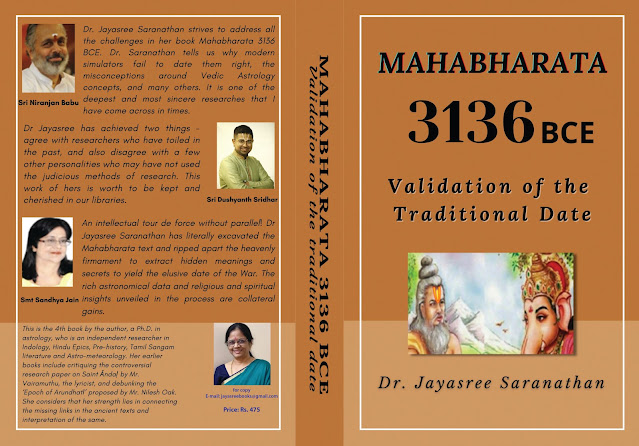
Published my book, “Mahabharata 3136 BCE: Validation of the Traditional Date

I am glad to announce the release of my book. “Mahabharata 3136 BCE: Validation of the Traditional Date” on the occasion of the completion of birth centenary of my father today. This book dedicated to my father is released by his Ācārya swami, Sri U. Ve. Ko. Ka. Appan Praṇatārtiharācāriār Swāmi at his Tirumāḷigai near Sri Varadarāja Perumāl temple in Kāncipuram. 


I am privileged to get the manuscript read and fore-worded by three luminaries from three fields related to the Mahābhārata – astrology, religious literature and civilizational studies. I am indebted to Sri Niranjan Babu, the Chief Editor of The Astrological eMagazine and the son of the illustrious Dr. B. V. Raman for reading the manuscript and giving his valuable feedback. My gratitude finds no bounds for the foreword given by ‘Pravachana Ratna Mani’, Sri Dushyanth Sridhar. I am at a loss for words to express my gratefulness to Smt Sandhya Jain for proof-reading the text and giving her valuable thoughts about the book.

This book authenticates the year of the Mahābhārata war as 3136 BCE, embedded in the Text of the Mahābhārata as the 36th year before Kṛṣṇa left on 3101 BCE when the current Time period of Kali Mahā Yuga began. It is important to validate this date to position the Mahābhārata in the Indic chronology to synchronize with the archaeological findings in Harappan settlements. The appearance of these settlements with advanced city planning and material culture could not have been sudden but a continuation of a pre-existing civilization. Mahābhārata offers the link to that pre-history.

This book of 18 chapters deals with the problems in dating, particularly with the use of astronomy simulators in the first Part where the issues around Kali Yuga date are settled textually and epigraphically. The second Part focuses on validating the date using the inputs on nimitta-s of terrestrial, atmospheric and celestial observations and syncing them with the traditional calendric references given in the text.

A surprise revelation of the systematic study of these inputs is the discovery of a cosmic impact, embedded in the GISP2 temperature graph of the Holocene - that makes the Mahābhārata a true historical document of mankind's first-ever eye-witness record of the crash of a fragmented comet on the earth and the moon simultaneously. The impact caused early Amāvāsyā on the 13th tithi, that was perpetuated into memory as Bodhāyana Amāvāsyā and pushed the earth into a longer path causing a delay of Uttarāyaṇa, forcing Bhīṣma to wait on the arrow bed. The tithi-star alignment changed forever- the changed alignment  continuing even now- and is remembered as Ratha Saptamī. With so many tricky issues concealed in the Mahābhārata requiring us to follow Lord Gaṇeśa-moment every now and then, this book seeks to solve the incomprehensible verses to establish the date as the 36th year before Kali Yuga began.

The decipherment continues to uncover the location of Kṛṣṇa’s Dwārakā and the causes for its loss. The focus then shifts to what happened to the remaining population of Dwārakā who fled the city after the deluge. The Epilogue gives the details of their settlements. The early Harappan regions being home to many Mahābhārata characters including the maternal ancestors of the Kuru-clan, the home of the son-in law of the Kaurava-s and animal motifs of the Harappan the same as those of the losers of the Mahābhārata war, the validation of the date of Mahābhārata gains significance by offering the hitherto unknown two phases of the Early Harappan, as pre-Mahābhārata and post-Mahābhārata, with the latter offering continuity to Mature Harappan with fresh settlements of the displaced people of the Dwārakā-flood, starting the Sarasvatī culture. 

The Epilogue further traces the second migration of the Dwārakā-people from the Sarasvatī region around 1500 BCE to Bet Dwārakā and to South India. Yet another migration from the Sindhu region to South India had taken place around 2000 years ago. The Epilogue also offers inputs from the Rāmāyana of Vālmīki on the autochthonous origin of the Yamnaya people in India in the 7th millennium BCE.

The printed copy of this book running into 436 pages and priced at Rs. 475 (postal charges extra) can be obtained by sending an e-mail to jayasreebooks@gmail.com

The e-book is available at Amazon.com

https://www.amazon.in/dp/B09LS1WZ4X (India)

https://www.amazon.com/dp/B09LS1WZ4X (USA)

https://www.amazon.co.uk/dp/B09LS1WZ4X (UK)

https://www.amazon.de/dp/B09LS1WZ4X (Germany)

https://www.amazon.fr/dp/B09LS1WZ4X (France)

https://www.amazon.es/dp/B09LS1WZ4X (Spain)

https://www.amazon.com.au/dp/B09LS1WZ4X (Australia)

Readers can leave their comments, opinions and suggestions in the comment section of this blog.